
• Latest
  • Trending
  • All
See It Now: Sturgeon Supermoon and Saturn’s Rare Moment

See It Now: Sturgeon Supermoon and Saturn’s Rare Moment

August 13, 2024
Artemis 2 astronauts saw the moon with different eyes

Artemis 2 astronauts saw the moon with different eyes: Amazing!

May 14, 2026
An X-ray key to the Red Dot mystery

An X-ray key to the Red Dot mystery: Stunning!

May 14, 2026
ADVERTISEMENT
A close brush with Mars will reshape

A close brush with Mars will reshape: Incredible!

May 14, 2026
The birthplace of cosmic buckyballs

The birthplace of cosmic buckyballs: Amazing news!

May 14, 2026
tiny world in the outer solar system

This tiny world in the outer solar system is shocking

May 13, 2026
3I ATLAS came from a strange

3I ATLAS came from a strange, cold world: Remarkable!

May 13, 2026
The biochemical dawn of early earth

The biochemical dawn of early earth: Amazing discovery!

May 13, 2026
The material science behind a spacecraft

The material science behind a spacecraft: Essential!

May 13, 2026
Black holes don't live forever

Black holes don’t live forever: Shocking news!

May 12, 2026
largest impact crater scattered

The moon’s largest impact crater scattered priceless news

May 12, 2026
Vast atmospheric waves on Venus

Vast atmospheric waves on Venus: Incredible discovery!

May 12, 2026
These monster black holes did not form

These monster black holes did not form normally: Scary!

May 12, 2026
NASA Space News
No Result
View All Result
  • Home
  • Missions
    SIMP-0136 weather report

    SIMP-0136 Weather Report Reveals Storms and Auroras on a Rogue World

    Moon-forming disk

    JWST Reveals the Chemistry Inside a Moon-forming disk

    Little Red Dots

    Are the “Little Red Dots” Really Black Hole Stars? What JWST Is Revealing About the Early Universe

    Pismis 24 Star Cluster

    Inside the Lobster Nebula: Pismis 24 Star Cluster Unveiled

    Comet Lemmon

    A Rare Cosmic Visitor: Will Comet Lemmon Light Up October Sky?

    Butterfly Star

    The Butterfly Star: How James Webb New Discovery Unlocks Secrets of Planet Formation

    James Webb Space Telescope

    A Cosmic Masterpiece: James Webb Space Telescope Reveals the Heart of a Stellar Nursery

    interstellar comet

    A Cosmic Visitor Lights Up Our Solar System: The Story of Interstellar Comet 3I/ATLAS

    Interstellar comet 3I/ATLAS

    How TESS Spotted the Interstellar Comet 3I/ATLAS Early—and What It Means for Science

  • Planets
  • Astrophysics
  • Technology
  • Research
  • About
  • Contact Us
NASA Space News
No Result
View All Result
Home Moon

See It Now: Sturgeon Supermoon and Saturn’s Rare Moment

by nasaspacenews
August 13, 2024
in Moon, Others, Solar System
0
See It Now: Sturgeon Supermoon and Saturn’s Rare Moment

A composite capture of Saturn versus the Moon, minutes before the March 31st occultation in 2019. Image credit and copyright: Cory Schmitz, PhotographingSpace.com

Share on FacebookShare on Twitter

The upcoming August 2024 “Sturgeon Moon” is generating excitement among skywatchers, as it marks the first supermoon of the year. Set to reach its peak illumination on August 19 at 2:26 PM EDT, this celestial event will be visible across the sky after sunset, offering a stunning visual spectacle. But what makes this supermoon so special, and why is it important? Let’s dive into the details.

The “Sturgeon Moon” gets its name from the giant lake sturgeon that were once abundant in the Great Lakes and Lake Champlain during this time of year. Native American tribes and early settlers relied on these fish as a vital food source, and the full moon in August was named in their honor.

This August, the Sturgeon Moon isn’t just any full moon; it’s a supermoon which occurs when the moon is near its closest approach to Earth, known as perigee. During this time, the moon appears about 7-10% larger and significantly brighter than a typical full moon. While the difference in size might be subtle to the casual observer, the combination of the moon’s proximity and the optical illusion created by its low position on the horizon can make the moon look impressively large as it rises or sets. This phenomenon is why supermoons are such a visual treat and a favorite for photographers and sky enthusiasts alike.

ADVERTISEMENT
Super Moon vs. Micro Moon
Image Credit & Copyright: Catalin Paduraru

The Sturgeon Moon is particularly noteworthy as it kicks off a series of four consecutive supermoons. The supermoon itself doesn’t change the moon’s physical properties, but it does offer a more vivid and engaging viewing experience. For those fascinated by astronomy, this supermoon series presents a unique opportunity to observe how slight variations in distance can impact the moon’s appearance.

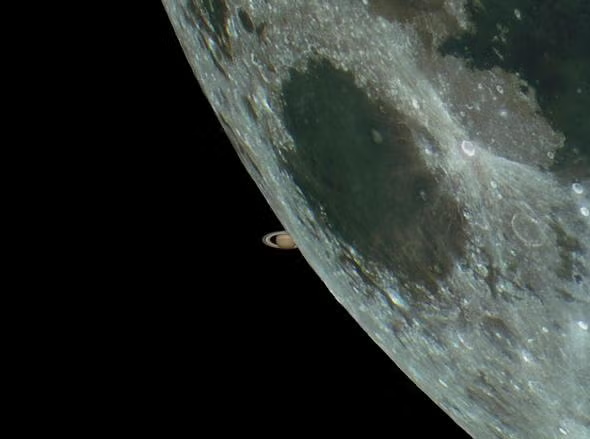
What makes the August 2024 Sturgeon Supermoon truly unique is its pairing with the occultation of Saturn. As the supermoon rises, Saturn will disappear behind it in a rare celestial alignment—a sight that hasn’t occurred since 2019. This occultation will be visible from  In various parts of the world, including regions in Africa and South America, the moon will pass in front of Saturn, temporarily obscuring the ringed planet from view which adds another layer of intrigue to an already captivating night, as it allows observers to witness the dynamic interactions between celestial bodies.
ADVERTISEMENT
A composite image showing what Saturn and the Moon looked like in mid-occultation in  May 14, 2014. Photo by Paul Stewart.

To fully appreciate this once-in-a-lifetime event, here are some tips on how to best witness the Sturgeon Supermoon and Saturn’s occultation:

  1. Check Local Viewing Times: The peak illumination of the Sturgeon Supermoon will occur at 2:26 PM EDT, but the best time to view the supermoon will be after sunset when it rises in the southeast. Use a moonrise calculator to determine the exact time for your location.
  2. Find a Clear Horizon: The supermoon will appear largest near the horizon due to the “moon illusion.” Find a location with an unobstructed view of the southeast horizon to fully enjoy this effect. High vantage points or open fields are ideal spots.
  3. Witness the Occultation: The occultation of Saturn will not be visible from all locations. If you’re in Africa or South America, you’re in luck. In places like Marrakech, Morocco, the occultation will begin at 4:07 AM local time. For those in North America, while the full occultation won’t be visible, Saturn will still be remarkably close to the supermoon, making for a spectacular sight. Use a stargazing app to track the moon and Saturn in real-time.
  4. Bring Binoculars or a Telescope: While the supermoon can be appreciated with the naked eye, binoculars or a small telescope will enhance your view of the lunar surface and Saturn’s rings, especially during the occultation.
  5. Plan a Viewing Party: This event is perfect for sharing with friends and family. Consider organizing a viewing party with fellow skywatchers to enjoy the supermoon and Saturn’s vanishing act together.
  6. Capture the Moment: For photographers, this is a prime opportunity to capture the supermoon in all its glory. Use a tripod for stability, and experiment with different exposures to highlight the moon’s details and the night sky

So, as August 19 approaches, be sure to set aside time to witness this extraordinary event. Whether you’re watching the supermoon rise over a familiar landscape or trying to catch a glimpse of Saturn during its brief occultation, the Sturgeon Moon promises to be a memorable and meaningful spectacle. It’s not just about seeing the moon; it’s about appreciating the rich tapestry of science, culture, and natural beauty that it represents.

FEATURED POST

tiny world in the outer solar system

This tiny world in the outer solar system is shocking

May 13, 2026
3I ATLAS came from a strange

3I ATLAS came from a strange, cold world: Remarkable!

May 13, 2026
The biochemical dawn of early earth

The biochemical dawn of early earth: Amazing discovery!

May 13, 2026
The material science behind a spacecraft

The material science behind a spacecraft: Essential!

May 13, 2026

EDITOR PICK'S

This tiny world in the outer solar system is shocking

May 13, 2026

3I ATLAS came from a strange, cold world: Remarkable!

May 13, 2026

The biochemical dawn of early earth: Amazing discovery!

May 13, 2026

The material science behind a spacecraft: Essential!

May 13, 2026

Black holes don’t live forever: Shocking news!

May 12, 2026

The moon’s largest impact crater scattered priceless news

May 12, 2026

Vast atmospheric waves on Venus: Incredible discovery!

May 12, 2026

STAY CONNECTED

Recent News

tiny world in the outer solar system

This tiny world in the outer solar system is shocking

May 13, 2026
3I ATLAS came from a strange

3I ATLAS came from a strange, cold world: Remarkable!

May 13, 2026

Category

  • Asteroid
  • Astrobiology
  • Astrology
  • Astronomy
  • Astrophotography
  • Astrophysics
  • Auroras
  • Black holes
  • Comets
  • Cosmology
  • Dark energy
  • Dark Matter
  • Earth
  • Euclid
  • Exoplanets
  • Galaxies
  • Jupiter
  • JWST
  • Mars
  • Mercury
  • Meteor showers
  • Missions
  • Moon
  • Neptune
  • News
  • Others
  • Planets
  • QuantumPhysics
  • quasars
  • Research
  • Rocks
  • Saturn
  • solar storm
  • Solar System
  • stars
  • sun
  • Technology
  • Universe
  • Uranus
  • Venus
  • Voyager

We bring you the latest news and updates in space exploration, innovation, and astronomy.

  • ABOUT US
  • CONTACT US
  • DISCLAIMER
  • PRIVACY POLICY
  • Terms of Service

© 2025 NASA Space News

No Result
View All Result
  • Home
  • Missions
  • Planets
  • Astrophysics
  • Technology
  • Research
  • About
  • Contact Us

© 2025 NASA Space News

Welcome Back!

Sign In with Facebook
Sign In with Google
Sign In with Linked In
OR

Login to your account below

Forgotten Password?

Retrieve your password

Please enter your username or email address to reset your password.

Log In

Add New Playlist