





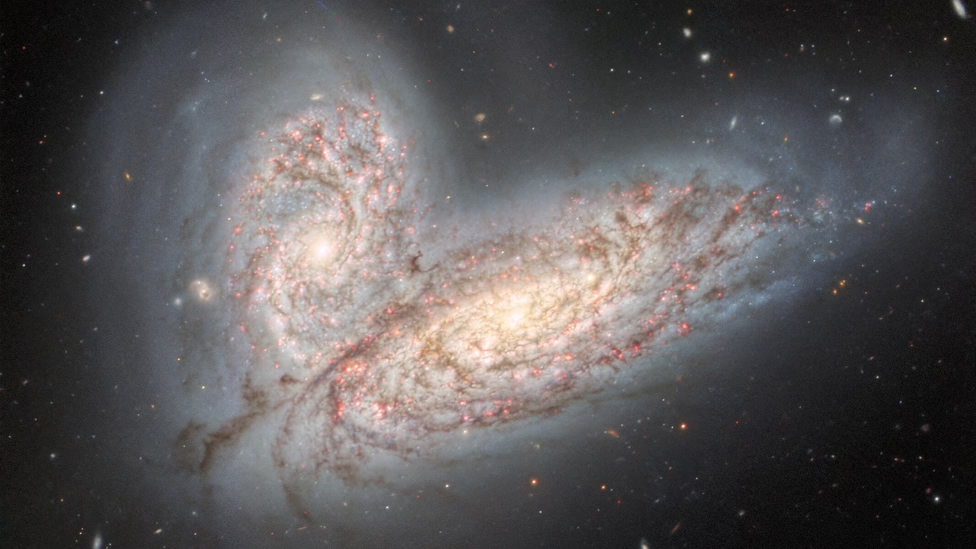
Astronomers have recently made a groundbreaking discovery that sheds light on the early universe’s formation of galaxies and black holes. Let’s explore how this discovery was made, its implications for our understanding of cosmic evolution, and why it is so important.
The Significance of Observing Merging Galaxies
Observing merging galaxies in the early universe is like looking back in time to witness the birth of the cosmos as we know it. When galaxies merge, the gravitational interactions can trigger intense star formation, known as starbursts, and activate quasars—extremely bright objects powered by supermassive black holes. According to a study published in The Astrophysical Journal, the recent observation of two merging galaxies, conducted by an international team led by Takuma Izumi, offers direct evidence that such mergers can lead to the formation of massive, bright galaxies.
This observation is significant because it supports the long-standing theory that galaxy mergers are crucial in forming supermassive black holes and the large-scale structures of the universe. When two gas-rich galaxies collide, the gravitational forces cause vast amounts of gas to fall towards the central black holes, triggering quasar activity. As astronomer Takuma Izumi explained, “This observation provides direct evidence for the long-held theory that galaxy mergers can trigger quasar activity,” emphasizing the importance of this discovery in understanding the universe’s early evolution.
The Methodology Behind the Discovery
The discovery of this galaxy merger was made possible through a combination of advanced observational techniques and powerful telescopes. The initial identification of the merging galaxies was made by Yoshiki Matsuoka using the Subaru Telescope. Later, detailed observations were conducted using ALMA, one of the most powerful radio telescopes in the world. Positioned in the high-altitude desert of northern Chile, ALMA can detect faint signals from the farthest reaches of the universe.
The ALMA observations revealed a “bridge” of gas and dust connecting the two galaxies, confirming that they are indeed in the process of merging. This bridge of material is a telltale sign that the galaxies are interacting gravitationally and are on their way to becoming a single, larger galaxy. Moreover, the ALMA data showed that these galaxies are exceptionally rich in gas, which is the raw material for new star formation and black hole growth. This finding indicates that the merger will likely trigger a rapid increase in star formation—known as a starburst—alongside vigorous quasar activity.
The Implications for Understanding Galaxy and Black Hole Formation
The implications of this discovery extend far beyond just observing two galaxies merging. It provides critical insights into how supermassive black holes, which reside at the centers of most large galaxies, formed in the early universe. One of the biggest puzzles in astronomy is understanding how these enormous black holes could have formed so quickly after the Big Bang. The recent observations of merging galaxies offer a possible answer: the mergers themselves might accelerate the growth of black holes by funneling large amounts of gas and dust into the galactic centers, feeding the black holes and causing them to grow rapidly.
Additionally, the combination of starburst activity and vigorous quasar activity suggests that the merging galaxies will eventually form a “monster galaxy,” one of the brightest and most massive objects in the universe. Such galaxies are rare, but they are incredibly important for understanding the early universe’s dynamics. They act as cosmic laboratories that allow scientists to study the processes that drive galaxy formation and evolution on the largest scales. As Yoshiki Matsuoka, one of the key researchers, noted, “We’re essentially witnessing the birth of a cosmic titan. These objects are crucial for understanding how the largest galaxies and most massive black holes in the universe came to be”.
The Broader Impact on Cosmology
This discovery has significant implications for the broader field of cosmology. By providing direct observational evidence that supports theories about galaxy and black hole formation in the early universe, it helps refine our understanding of how the cosmos evolved from a hot, dense state after the Big Bang to the vast, complex universe we see today. Understanding these early cosmic processes is crucial for piecing together the universe’s history and potentially predicting its future evolution.
Furthermore, this research also helps explain the presence of supermassive black holes in the first billion years after the Big Bang, which has long puzzled astronomers. The fact that such massive structures could exist so early in cosmic history suggests that galaxy mergers were likely more common in the early universe than previously thought. This insight will guide future observations and theoretical models aimed at understanding the formation and evolution of galaxies and black holes.
What This Means for Future Observations
The success of this study underscores the importance of advanced telescopes like ALMA in exploring the distant universe. It also highlights the need for future observations with next-generation telescopes, such as the James Webb Space Telescope (JWST), which can peer even deeper into the universe’s history. These tools will allow astronomers to observe more mergers and understand the conditions that lead to the formation of supermassive black holes and monster galaxies.
Future studies could focus on finding more merging galaxies at various stages of evolution to build a more comprehensive picture of how galaxies grow and change over time. By understanding these processes, scientists can gain new insights into the universe’s ultimate fate and how the cosmos has unfolded over billions of years.
In summary, the observation of merging galaxies 12.8 billion years ago offers a unique window into the early universe’s dynamic and violent processes. It provides valuable evidence that galaxy mergers are key drivers of star formation, quasar activity, and the growth of supermassive black holes. As we continue to push the boundaries of our observational capabilities, discoveries like this bring us closer to answering fundamental questions about the origins of the cosmos and our place within it. The universe is a vast and complex place, and each new discovery adds another piece to the puzzle, helping us understand the grand tapestry of cosmic history.
Research Reference
Izumi, T., Matsuoka, Y., et al. (2024). Merging Gas-rich Galaxies That Harbor Low-luminosity Twin Quasars at z = 6.05: A Promising Progenitor of the Most Luminous Quasars. The Astrophysical Journal, . https://doi.org/10.48550/arXiv.2405.02468


