
• Latest
  • Trending
  • All
New Clues from Space! Life’s Basic Ingredients Found in a Star-Forming Cloud

New Clues from Space! Life’s Basic Ingredients Found in a Star-Forming Cloud

October 27, 2024
NGC 6540's mysterious X-ray flare

NGC 6540’s mysterious X-ray flare: A baffling failure

June 15, 2026
The autonomous space fleet

The autonomous space fleet: A brilliant mission!

June 15, 2026
ADVERTISEMENT
How satellites are ruining everything

How satellites are ruining everything: A tragic era

June 15, 2026
How the universe will end

How the universe will end: Shocking new study results!

June 15, 2026
a rare sunset on Aug. 12, 2026

A rare sunset on Aug. 12, 2026: Stunning eclipse!

June 14, 2026
NASA chief defends all-male Artemis 3

NASA chief defends all-male Artemis 3: Bold choice!

June 14, 2026
The secret to black hole formation

The secret to black hole formation: Incredible discovery!

June 14, 2026
AI learned how the universe works

AI learned how the universe works: A Dark Setback

June 14, 2026
Strange spacetime crystals could

Strange spacetime crystals could trigger stunning collapse

June 11, 2026
Trouble near the Milky Way

Trouble near the Milky Way: A scary galactic collision

June 11, 2026
How to forecast alien weather

How to forecast alien weather: Amazing new method!

June 11, 2026
Technosignature Report on 3I ATLAS

Technosignature Report on 3I ATLAS: Surprising results!

June 11, 2026
NASA Space News
No Result
View All Result
  • Home
  • Missions
    SIMP-0136 weather report

    SIMP-0136 Weather Report Reveals Storms and Auroras on a Rogue World

    Moon-forming disk

    JWST Reveals the Chemistry Inside a Moon-forming disk

    Little Red Dots

    Are the “Little Red Dots” Really Black Hole Stars? What JWST Is Revealing About the Early Universe

    Pismis 24 Star Cluster

    Inside the Lobster Nebula: Pismis 24 Star Cluster Unveiled

    Comet Lemmon

    A Rare Cosmic Visitor: Will Comet Lemmon Light Up October Sky?

    Butterfly Star

    The Butterfly Star: How James Webb New Discovery Unlocks Secrets of Planet Formation

    James Webb Space Telescope

    A Cosmic Masterpiece: James Webb Space Telescope Reveals the Heart of a Stellar Nursery

    interstellar comet

    A Cosmic Visitor Lights Up Our Solar System: The Story of Interstellar Comet 3I/ATLAS

    Interstellar comet 3I/ATLAS

    How TESS Spotted the Interstellar Comet 3I/ATLAS Early—and What It Means for Science

  • Planets
  • Astrophysics
  • Technology
  • Research
  • About
  • Contact Us
NASA Space News
No Result
View All Result
Home Astrobiology

New Clues from Space! Life’s Basic Ingredients Found in a Star-Forming Cloud

by nasaspacenews
October 27, 2024
in Astrobiology, Astronomy, Astrophysics
0
New Clues from Space! Life’s Basic Ingredients Found in a Star-Forming Cloud

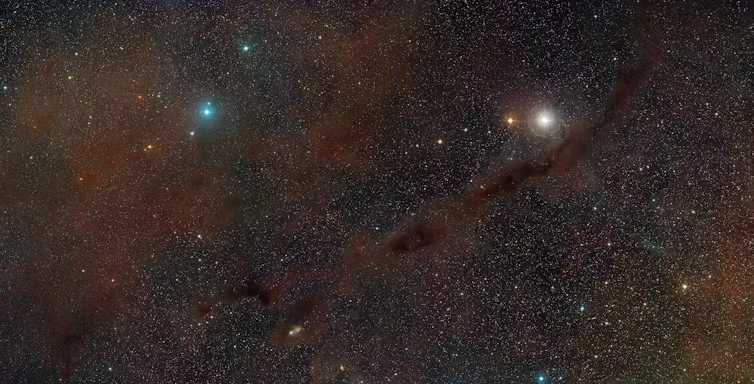
This image shows a wide-field view of part of the Taurus Molecular Cloud, about 450 light-years from Earth. Its relative closeness makes it an ideal place to study the formation of stars. Many dark clouds of obscuring dust are clearly visible against the background stars. Credit: Digitized Sky Survey 2. Acknowledgment: Davide De Martin.

Share on FacebookShare on Twitter

Scientists have long speculated that the building blocks of life might have originated in space, carried by ancient clouds of gas and dust before eventually seeding planets. This theory, known as panspermia, has gained new support from recent findings led by a team at MIT. By detecting 1-cyanopyrene, a molecule formed from the polycyclic aromatic hydrocarbon (PAH) pyrene, researchers found evidence that complex carbon structures are not only formed in space but may survive the harsh conditions of interstellar clouds long enough to potentially reach new worlds.

Table of Contents

Toggle
  • The Role of Complex Carbon Molecules in Life’s Origins
  • How Scientists Discovered 1-Cyanopyrene in the Taurus Molecular Cloud
  • The Resilience of Complex Molecules in Harsh Interstellar Conditions
  • Implications for Earth’s Origins and Beyond
  • Conclusion: Toward a Greater Understanding of Life’s Cosmic Origins

The Role of Complex Carbon Molecules in Life’s Origins

Carbon-based molecules, particularly PAHs, are crucial to life’s fundamental chemistry. PAHs, like pyrene, consist of multiple carbon rings and play a role in forming larger organic molecules that can eventually lead to life. The significance of PAHs lies in their stability and versatility in bonding, providing the backbone for organic chemistry. Pyrene itself is made up of 26 atoms and is one of the largest PAHs detected in interstellar space so far.

ADVERTISEMENT

The discovery of pyrene-related molecules in the Taurus molecular cloud supports the idea that life’s essential molecules were present in interstellar regions even before Earth formed. PAHs have already been found on meteorites and in distant galaxies, hinting that the fundamental chemistry supporting life might be widespread across the cosmos. This new evidence is another step forward in answering the age-old question: could life be more common in the universe than we thought?

How Scientists Discovered 1-Cyanopyrene in the Taurus Molecular Cloud

The search for 1-cyanopyrene was no easy feat. Unlike simpler molecules, complex PAHs are notoriously difficult to detect due to their low visibility in standard radio telescopic observations. To solve this, scientists at MIT used the Green Bank Telescope in West Virginia, a tool that can detect radio emissions from unique molecules like 1-cyanopyrene. This molecule acts as a “tracer” for pyrene, meaning it emits radio waves that reveal the likely presence of pyrene without requiring its direct detection.

ADVERTISEMENT

The technique of using tracers allows researchers to estimate the presence and quantity of more elusive molecules by observing their chemical interactions. In this case, 1-cyanopyrene was chosen because it forms from pyrene’s interaction with cyanide, a common compound in interstellar space.

The Resilience of Complex Molecules in Harsh Interstellar Conditions

One of the most striking aspects of this discovery is that pyrene—and by extension, other PAHs—can survive in the intense conditions present in star-forming regions. Previously, scientists believed that complex molecules would break down under the high-energy radiation typical of such environments. Yet, evidence from this study shows that pyrene can remain stable, even as clouds collapse to form stars and planets. This resilience was also observed in samples from the asteroid Ryugu, where large quantities of pyrene were detected, supporting the theory that such molecules have traveled through space and potentially reached Earth billions of years ago.

The ability of pyrene to withstand radiation means it could have been present during the formation of our Solar System. This challenges the traditional view that only simple molecules can survive in space and suggests that PAHs could be more common than we realize in the early environments of many planetary systems.

Implications for Earth’s Origins and Beyond

The discovery of complex carbon molecules in interstellar clouds has far-reaching implications for our understanding of life’s origins. For Earth, it supports the idea that vital organic compounds were “delivered” to the planet from space, potentially speeding up the development of prebiotic chemistry on early Earth. This notion aligns with the discovery of chiral molecules, which are necessary for life’s complex chemistry, in space. Together, these findings suggest that life’s raw materials could be widely distributed across the galaxy, waiting to take root in suitable environments.

The detection of 1-cyanopyrene also opens doors for the study of exoplanetary atmospheres and surfaces. If PAHs are common in interstellar clouds, they may also be found in the atmospheres of planets orbiting distant stars, particularly those in habitable zones. This widens the scope of astrobiology, as planets with a high concentration of organic molecules could be prime candidates in the search for life.

Conclusion: Toward a Greater Understanding of Life’s Cosmic Origins

In sum, the discovery of complex molecules like 1-cyanopyrene in interstellar clouds is a major step forward in understanding life’s beginnings. These molecules’ resilience and abundance suggest that the seeds of life could exist in many places across the universe, potentially fostering life on planets far beyond our own Solar System. As technology advances, scientists hope to detect more complex compounds and analyze their distributions across various star systems.

Reference:

Soma, T., Sakai, N., Watanabe, Y., & Yamamoto, S. . Complex organic molecules in Taurus Molecular Cloud-1.

Tags: 1-cyanopyrenebuilding blocks of lifecomplex carbon moleculesGreen Bank Telescopeinterstellar discoveryMIT astronomyorganic moleculesorigins of lifePAH discoverypanspermia theorypolycyclic aromatic hydrocarbonspyrene in spacespace chemistryTaurus molecular cloud

FEATURED POST

NGC 6540's mysterious X-ray flare

NGC 6540’s mysterious X-ray flare: A baffling failure

June 15, 2026
The autonomous space fleet

The autonomous space fleet: A brilliant mission!

June 15, 2026
How satellites are ruining everything

How satellites are ruining everything: A tragic era

June 15, 2026
How the universe will end

How the universe will end: Shocking new study results!

June 15, 2026

EDITOR PICK'S

NGC 6540’s mysterious X-ray flare: A baffling failure

June 15, 2026

The autonomous space fleet: A brilliant mission!

June 15, 2026

How satellites are ruining everything: A tragic era

June 15, 2026

How the universe will end: Shocking new study results!

June 15, 2026

A rare sunset on Aug. 12, 2026: Stunning eclipse!

June 14, 2026

NASA chief defends all-male Artemis 3: Bold choice!

June 14, 2026

The secret to black hole formation: Incredible discovery!

June 14, 2026

STAY CONNECTED

Recent News

NGC 6540's mysterious X-ray flare

NGC 6540’s mysterious X-ray flare: A baffling failure

June 15, 2026
The autonomous space fleet

The autonomous space fleet: A brilliant mission!

June 15, 2026

Category

  • Asteroid
  • Astrobiology
  • Astrology
  • Astronomy
  • Astrophotography
  • Astrophysics
  • Auroras
  • Black holes
  • Comets
  • Cosmology
  • Dark energy
  • Dark Matter
  • Earth
  • Euclid
  • Exoplanets
  • Galaxies
  • Jupiter
  • JWST
  • Mars
  • Mercury
  • Meteor showers
  • Missions
  • Moon
  • Neptune
  • News
  • Others
  • Planets
  • QuantumPhysics
  • quasars
  • Research
  • Rocks
  • Saturn
  • solar storm
  • Solar System
  • stars
  • sun
  • Technology
  • Universe
  • Uranus
  • Venus
  • Voyager

We bring you the latest news and updates in space exploration, innovation, and astronomy.

  • ABOUT US
  • CONTACT US
  • DISCLAIMER
  • PRIVACY POLICY
  • Terms of Service

© 2025 NASA Space News

No Result
View All Result
  • Home
  • Missions
  • Planets
  • Astrophysics
  • Technology
  • Research
  • About
  • Contact Us

© 2025 NASA Space News

Welcome Back!

Sign In with Facebook
Sign In with Google
Sign In with Linked In
OR

Login to your account below

Forgotten Password?

Retrieve your password

Please enter your username or email address to reset your password.

Log In

Add New Playlist