
• Latest
  • Trending
  • All
DESI Reveals a Cosmic Twist: Is Dark Energy Losing Its Power?

DESI Reveals a Cosmic Twist: Is Dark Energy Losing Its Power?

August 19, 2024
3D-visualization-of-soliton-knots-in-energy-fields-solving-problem-of-matter-asymmetry-through-Peccei-Quinn-symmetry-mechanisms

Problem of Matter Asymmetry : New Physics Solution Proposed

December 4, 2025
Stardust Found in NASA Bennu Samples: Life’s Molecular Origins Revealed

Stardust Found in NASA Bennu Samples: Life’s Molecular Origins Revealed

December 4, 2025
ADVERTISEMENT
Artist's depiction of futuristic Martian base showing how astronauts could build houses on Mars using sustainable bacterial technology

Build Houses on Mars With Bacteria: Revolutionary Settlement Technology

December 4, 2025
Turn Space Debris Into Future Spacecraft

Turn Space Debris Into Future Spacecraft – Circular Economy Concept

December 3, 2025
Rare Open Cluster Association – PHR J1724-3859 Connected to Trumpler 25

Rare Open Cluster Association – PHR J1724-3859 Connected to Trumpler 25

December 3, 2025
JWST find an exomoon

JWST Find an Exomoon: Sunspot Mimics Moon Signal in New Study

December 3, 2025
Cosmic Halo Spin : Dark Matter-Dark Energy Interaction Shapes Structure

Cosmic Halo Spin : Dark Matter-Dark Energy Interaction Shapes Structure

December 2, 2025
Moon rocks reveal stunning clues

Moon Rocks Reveal Stunning Clues About Theia’s Missing Planet

December 2, 2025
search for habitable worlds

Search for Habitable Worlds – New Tectonic Framework Discovered

December 2, 2025
Water Retention on Earth-Like Planets : Variable Stars Study Results

Water Retention on Earth-Like Planets : Variable Stars Study Results

December 1, 2025
Tiny Red Dot in Deep Space : New Cosmic Monster Discovered

Tiny Red Dot in Deep Space : New Cosmic Monster Discovered

December 1, 2025
Local space weather

Local Space Weather Impacts Vary More Than Expected Across Regions

December 1, 2025
ADVERTISEMENT
NASA Space News
No Result
View All Result
  • Home
  • Missions
    SIMP-0136 weather report

    SIMP-0136 Weather Report Reveals Storms and Auroras on a Rogue World

    Moon-forming disk

    JWST Reveals the Chemistry Inside a Moon-forming disk

    Little Red Dots

    Are the “Little Red Dots” Really Black Hole Stars? What JWST Is Revealing About the Early Universe

    Pismis 24 Star Cluster

    Inside the Lobster Nebula: Pismis 24 Star Cluster Unveiled

    Comet Lemmon

    A Rare Cosmic Visitor: Will Comet Lemmon Light Up October Sky?

    Butterfly Star

    The Butterfly Star: How James Webb New Discovery Unlocks Secrets of Planet Formation

    James Webb Space Telescope

    A Cosmic Masterpiece: James Webb Space Telescope Reveals the Heart of a Stellar Nursery

    interstellar comet

    A Cosmic Visitor Lights Up Our Solar System: The Story of Interstellar Comet 3I/ATLAS

    Interstellar comet 3I/ATLAS

    How TESS Spotted the Interstellar Comet 3I/ATLAS Early—and What It Means for Science

  • Planets
  • Astrophysics
  • Technology
  • Research
  • About
  • Contact Us
NASA Space News
No Result
View All Result
ADVERTISEMENT
Home Astrophysics

DESI Reveals a Cosmic Twist: Is Dark Energy Losing Its Power?

by nasaspacenews
August 19, 2024
in Astrophysics, Dark energy, News, Others, Universe
0
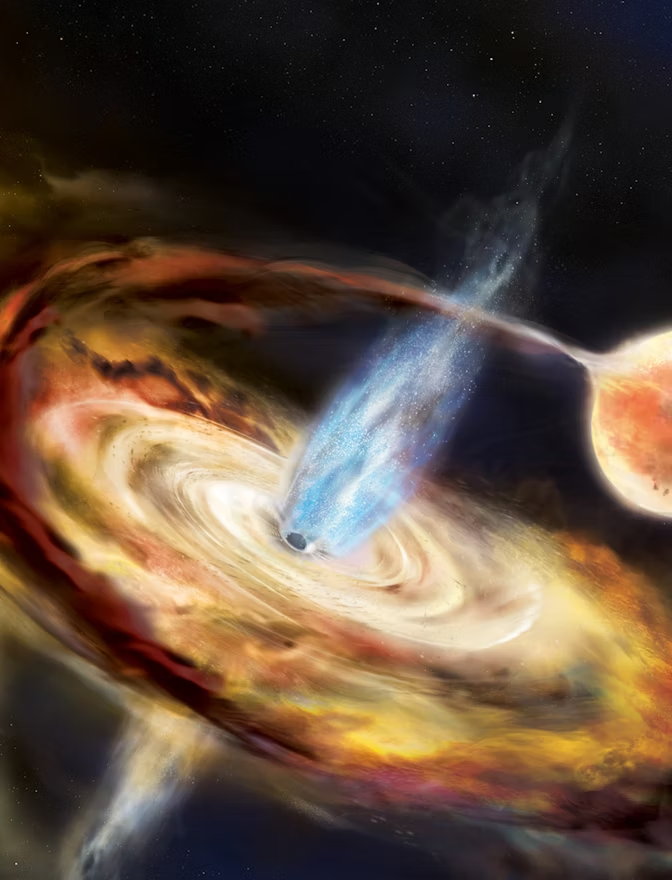
DESI Reveals a Cosmic Twist: Is Dark Energy Losing Its Power?

credits: NASA’s Goddard Space Flight Center

ADVERTISEMENT
Share on FacebookShare on Twitter

Table of Contents

Toggle
  • Dark Energy: Could the Universe’s Mysterious Force Be Weakening?
  • A New Twist in Dark Energy Research
  • How DESI is Unveiling the Secrets of the Universe’s Expansion
  • The Implications of a Weakening Dark Energy
  • What’s Next for Dark Energy Research?
  • References

Dark Energy: Could the Universe’s Mysterious Force Be Weakening?

Recent findings from the Dark Energy Spectroscopic Instrument (DESI) have sent shockwaves through the astrophysics world, challenging everything we thought we knew about the universe. Dark energy, long considered the mysterious force behind the universe’s ever-accelerating expansion, might not be as stable as once believed. DESI’s latest data hints that this powerful force could be weakening—a revelation that, if proven true, could drastically alter our understanding of the cosmos and the ultimate fate of everything within it.

A New Twist in Dark Energy Research

For over two decades, scientists have understood dark energy as a cosmological constant, a steady and unchanging force that permeates space and drives the universe’s expansion. This theory aligns with Einstein’s cosmological constant, introduced in the equations of general relativity to represent a repulsive force balancing gravity. However, DESI’s recent results are challenging that long-held belief. The collaboration has mapped 6.4 million galaxies so far, with plans to reach 40 million by the end of its survey. By analyzing the distribution of galaxies over time, DESI has found hints that dark energy might not be as constant as previously believed.

This is an intriguing possibility, as an evolving dark energy could change how we predict the universe’s future. If dark energy is not a static force, but rather one that weakens over time, it may suggest that the accelerating expansion of the universe will not last indefinitely. Instead, the universe could enter a new phase of expansion or contraction, shifting the fundamental dynamics of cosmic evolution. This is an enormous shift from the idea that the universe will continue expanding forever, driven by a constant dark energy.

What makes this finding so exciting is the potential it holds to overturn a core assumption in cosmology. Since the discovery of dark energy in 1998, the standard model of cosmology has relied on the idea that dark energy is constant. If DESI’s hints are correct, and dark energy is indeed weakening, it could mean that the acceleration of the universe’s expansion may eventually slow down or stop.

How DESI is Unveiling the Secrets of the Universe’s Expansion

DESI’s results are based on the largest 3D map of the universe ever created, made possible by observing millions of galaxies. By studying how these galaxies move, DESI can determine how fast the universe is expanding at different points in time. The key to this study is observing distant galaxies, which reveal how the universe behaved billions of years ago. The further away a galaxy is, the younger the universe was when its light began its journey to us.

In particular, DESI is focusing on the so-called “cosmic distance ladder”—a series of methods astronomers use to measure distances in space. By understanding the relationship between distance and the redshift of galaxies (the stretching of light as the universe expands), DESI can more accurately measure how the universe’s expansion rate has changed. Although DESI’s data alone isn’t enough to definitively prove that dark energy is changing, the combined data sets show a trend that hints at this possibility. As DESI continues its survey, scientists expect to gather even more data to clarify whether dark energy is truly evolving.

ADVERTISEMENT

The Implications of a Weakening Dark Energy

One of the most profound implications of weakening dark energy is the potential shift in the ultimate fate of the universe. For years, the most popular scenario has been the “Big Freeze,” where the universe continues expanding at an accelerating rate, eventually stretching out all matter and energy until the cosmos becomes cold and lifeless. However, if dark energy weakens, the Big Freeze may not occur. Instead, the expansion of the universe could slow, halt, or even reverse. In this case, a “Big Crunch” scenario might become more plausible, where the universe contracts back into a singularity.

This finding also ties into broader theoretical debates about dark energy. Some physicists have hypothesized that dark energy could be a dynamic force, rather than a constant one. Known as “quintessence,” this theory suggests that dark energy could vary in strength over time, much like other forces in nature. Quintessence could evolve, either increasing or decreasing in its intensity, depending on cosmic conditions. If DESI’s hints of a weakening dark energy are confirmed, it would lend support to these theories and push cosmologists to develop new models that better explain how dark energy behaves.

What’s Next for Dark Energy Research?

As DESI continues its five-year survey, researchers are eagerly awaiting more data to confirm these initial findings. Over the next few years, DESI will map 40 million galaxies, providing an even more detailed picture of the universe’s expansion. This comprehensive data set will be crucial in determining whether dark energy truly evolves over time or whether other factors are at play. If the hints of evolving dark energy are validated, it could revolutionize our understanding of the cosmos and its ultimate fate.

This discovery could also influence theoretical physics, particularly in areas like quantum mechanics and gravity, as scientists work to reconcile this new understanding of dark energy with other fundamental forces in the universe. In particular, the interplay between dark energy and quantum fluctuations could reveal new insights into the fabric of spacetime itself. The discovery of evolving dark energy might push physicists to explore new aspects of string theory or the concept of the multiverse, as these theories could help explain the changing nature of dark energy.

In the meantime, theorists are already exploring the potential implications of a weakening dark energy. Some have suggested that the universe could enter a new phase where the expansion slows or even reverses. Others are looking into how these findings align with existing models, such as string theory or the multiverse hypothesis. Whatever the outcome, DESI’s work represents a major step forward in our quest to understand the mysteries of dark energy and the future of the universe. As we continue to gather more data, we may be on the brink of a major paradigm shift in cosmology—one that changes the way we view the cosmos and its ultimate destiny.


References

  1. [Dark Energy Spectroscopic Instrument Collaboration Report, 2024]
  2. [NASA’s Cosmology Overview on Dark Energy, 2024]
Tags: astrophysics researchcosmology newsdark energyuniverse

FEATURED POST

3D-visualization-of-soliton-knots-in-energy-fields-solving-problem-of-matter-asymmetry-through-Peccei-Quinn-symmetry-mechanisms

Problem of Matter Asymmetry : New Physics Solution Proposed

December 4, 2025
Stardust Found in NASA Bennu Samples: Life’s Molecular Origins Revealed

Stardust Found in NASA Bennu Samples: Life’s Molecular Origins Revealed

December 4, 2025
Artist's depiction of futuristic Martian base showing how astronauts could build houses on Mars using sustainable bacterial technology

Build Houses on Mars With Bacteria: Revolutionary Settlement Technology

December 4, 2025
Turn Space Debris Into Future Spacecraft

Turn Space Debris Into Future Spacecraft – Circular Economy Concept

December 3, 2025

EDITOR PICK'S

Problem of Matter Asymmetry : New Physics Solution Proposed

December 4, 2025

Stardust Found in NASA Bennu Samples: Life’s Molecular Origins Revealed

December 4, 2025

Build Houses on Mars With Bacteria: Revolutionary Settlement Technology

December 4, 2025

Turn Space Debris Into Future Spacecraft – Circular Economy Concept

December 3, 2025

Rare Open Cluster Association – PHR J1724-3859 Connected to Trumpler 25

December 3, 2025

JWST Find an Exomoon: Sunspot Mimics Moon Signal in New Study

December 3, 2025

Cosmic Halo Spin : Dark Matter-Dark Energy Interaction Shapes Structure

December 2, 2025

STAY CONNECTED

Recent News

3D-visualization-of-soliton-knots-in-energy-fields-solving-problem-of-matter-asymmetry-through-Peccei-Quinn-symmetry-mechanisms

Problem of Matter Asymmetry : New Physics Solution Proposed

December 4, 2025
Stardust Found in NASA Bennu Samples: Life’s Molecular Origins Revealed

Stardust Found in NASA Bennu Samples: Life’s Molecular Origins Revealed

December 4, 2025

Category

  • Asteroid
  • Astrobiology
  • Astrology
  • Astronomy
  • Astrophotography
  • Astrophysics
  • Auroras
  • Black holes
  • Comets
  • Cosmology
  • Dark energy
  • Dark Matter
  • Earth
  • Euclid
  • Exoplanets
  • Galaxies
  • Jupiter
  • JWST
  • Mars
  • Mercury
  • Meteor showers
  • Missions
  • Moon
  • Neptune
  • News
  • Others
  • Planets
  • QuantumPhysics
  • quasars
  • Research
  • Rocks
  • Saturn
  • solar storm
  • Solar System
  • stars
  • sun
  • Technology
  • Universe
  • Uranus
  • Venus
  • Voyager

We bring you the latest news and updates in space exploration, innovation, and astronomy.

  • ABOUT US
  • CONTACT US
  • DISCLAIMER
  • PRIVACY POLICY
  • Terms of Service

© 2025 NASA Space News

No Result
View All Result
  • Home
  • Missions
  • Planets
  • Astrophysics
  • Technology
  • Research
  • About
  • Contact Us

© 2025 NASA Space News

Welcome Back!

Sign In with Facebook
Sign In with Google
Sign In with Linked In
OR

Login to your account below

Forgotten Password?

Retrieve your password

Please enter your username or email address to reset your password.

Log In

Add New Playlist