





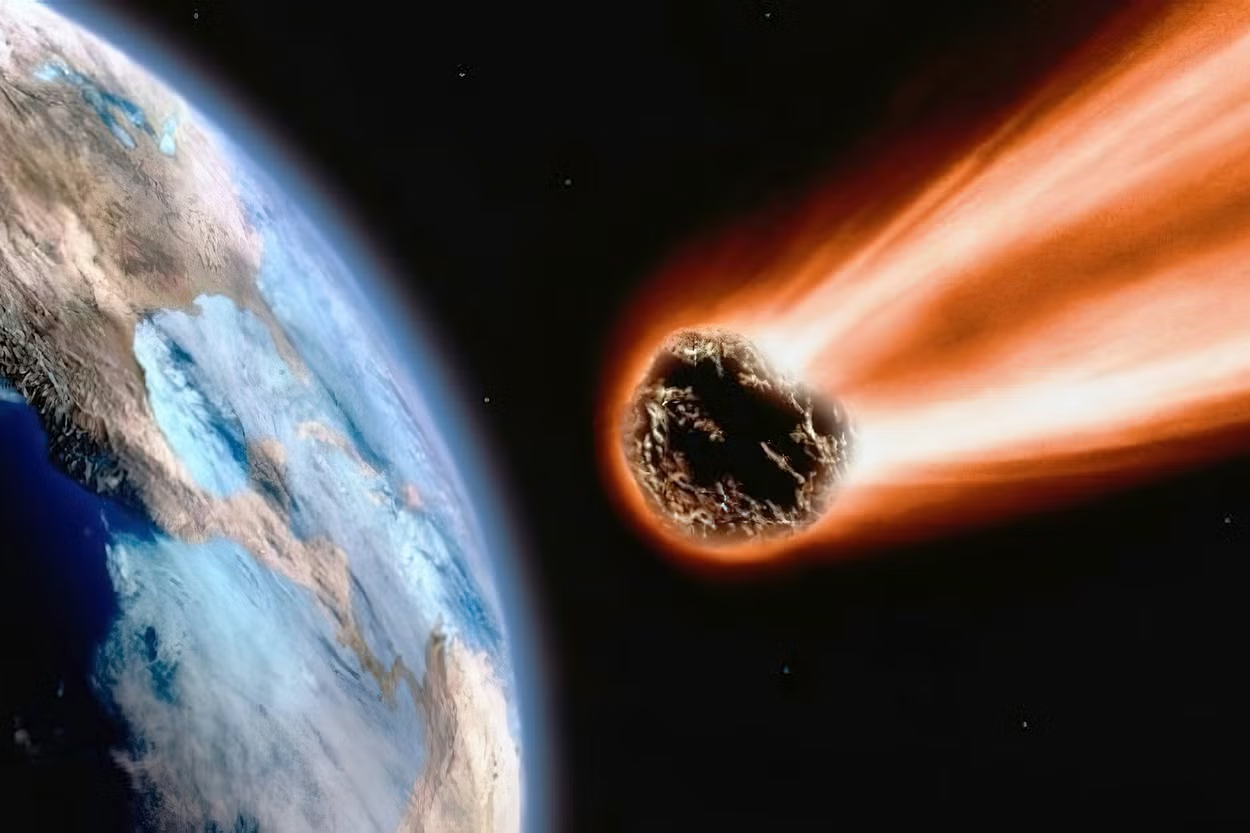
Imagine looking up and knowing five massive asteroids are speeding past Earth within the next week. Sounds like a disaster movie, right? Beyond the headlines, these close encounters are routine and reveal crucial insights into planetary defense and the secrets of our solar system. Prepare to be amazed by the science behind tracking these celestial visitors and what they teach us about our place in the universe.
Asteroids in Our Neighborhood
The five asteroids making close approaches to Earth range in size from a bus to an airplane, but none of them pose a real threat. According to NASA, these asteroids, while relatively large (between 38 and 210 feet in diameter), will pass within a safe distance of Earth, ranging from 1.6 million to 4.3 million miles away.
These distances may seem alarming at first, but they are quite large in cosmic terms. For context, the average distance between the Earth and the Moon is about 239,000 miles, which means that these asteroids will be several times farther away than our lunar neighbor.
NASA classifies these close approaches as “routine” since they happen regularly without posing a danger to our planet.
Understanding these distances helps to calm public fears while also emphasizing the importance of tracking even the most routine near-Earth objects (NEOs). The next time you hear about an asteroid coming close to Earth, you’ll know that NASA is closely monitoring the situation and has the data to ensure there is no imminent risk.
The Role of NASA’s Asteroid Watch Program
NASA’s Asteroid Watch Program plays a crucial role in monitoring and predicting asteroid paths, using advanced technologies to ensure planetary safety.
NASA’s Jet Propulsion Laboratory (JPL) runs the Asteroid Watch Dashboard, a platform that tracks near-Earth objects, including comets and asteroids, that make close approaches to our planet. The dashboard provides up-to-date information on the size, speed, and proximity of these objects.
The Asteroid Watch Program is part of NASA’s broader planetary defense strategy. By tracking asteroids well in advance, scientists can accurately predict their trajectories, ensuring that even if an object were to pose a risk, we would have ample warning. This data is collected using ground-based telescopes and radar, allowing NASA to map the orbits of these objects and predict their movements with great precision.
The Asteroid Watch Program doesn’t just protect Earth; it also provides valuable data for scientific research. Each close approach offers a unique opportunity to study the characteristics of these space rocks, helping us better understand the origins and dynamics of our solar system.
Why Close Approaches Matter
Even though these asteroids won’t impact Earth, their close approaches offer critical opportunities for scientific observation and study. Scientists use these close encounters to study asteroids’ composition, shape, and speed. NASA’s OSIRIS-REx mission, for instance, was able to collect samples from asteroid Bennu, which will help scientists understand the building blocks of the solar system.
When an asteroid passes close to Earth, it provides astronomers with a rare chance to gather detailed data about its structure and composition. This information helps us learn more about the early solar system, as many asteroids are remnants from that period. Moreover, these close approaches allow scientists to refine their models for asteroid impact probabilities, making future predictions even more accurate.
The Science Behind Planetary Defense
Monitoring asteroids is a key component of planetary defense, a growing field that focuses on preventing potential impacts from near-Earth objects. NASA’s Planetary Defense Coordination Office (PDCO) was established to oversee efforts related to detecting, tracking, and characterizing potentially hazardous objects. This includes developing strategies to deflect or destroy asteroids if necessary. In 2022, NASA’s Double Asteroid Redirection Test (DART) successfully altered the orbit of an asteroid, proving that we can protect our planet from future threats.
Planetary defense isn’t just a theoretical exercise—it’s a practical science aimed at safeguarding Earth from celestial hazards. By monitoring NEOs and developing deflection techniques, scientists are working on ways to prevent catastrophic impacts. The DART mission marked a significant milestone in this field, demonstrating that humanity has the ability to change the course of an asteroid.
The science of planetary defense is still in its early stages, but each successful mission brings us closer to ensuring that Earth remains safe from potential asteroid impacts.
Why This Matters for the Future
The current wave of asteroids approaching Earth underscores the importance of continued investment in space observation and planetary defense technologies. According to NASA, while the likelihood of a major asteroid impact is low, the consequences of such an event could be devastating. That’s why NASA, in collaboration with international space agencies, continues to invest in asteroid tracking and deflection technologies.
The study and monitoring of asteroids serve not only to protect Earth but also to advance our understanding of the universe. As we continue to explore and observe, we are also laying the groundwork for future missions that could one day save our planet. In the grand scheme of things, tracking asteroids may seem like a niche field, but its implications are vast. By investing in these technologies today, we are preparing for the uncertainties of tomorrow.
The recent asteroid approaches are a reminder of the importance of vigilance and preparation. NASA’s efforts in this area reflect a broader trend in space exploration, where the focus is not just on discovery but on protection and prevention.
Close encounters like these provide a glimpse into the broader context of space safety. The collaboration between international space agencies shows that protecting Earth is a global effort. In recent years, we’ve seen an uptick in interest from private companies and other nations in contributing to planetary defense strategies. This convergence of efforts signifies the growing importance of not only observing these celestial bodies but also ensuring that our technological and scientific capabilities continue to evolve.
Reference
Chesley, S. R., & Spahr, T. B. (2004). “Earth impactors: Orbital characteristics and warning times.” In Mitigation of hazardous comets and asteroids, (pp. 22-38). Cambridge University Press. DOI: 10.1017/CBO9780511536106.


