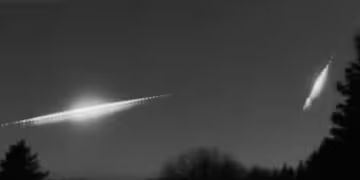





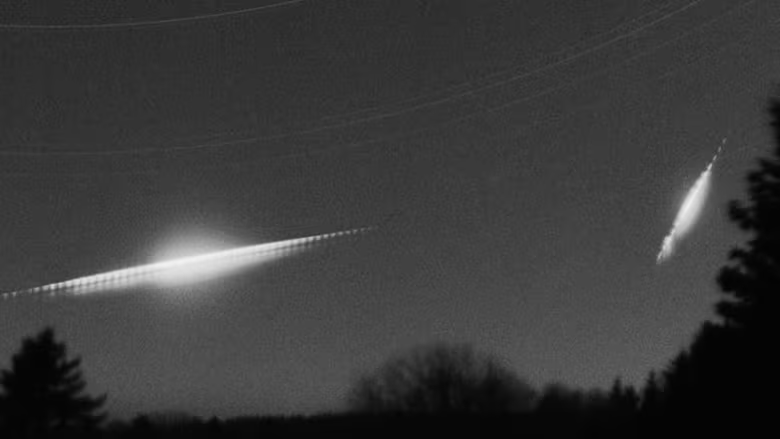
The Taurid asteroid swarm has raised concerns about hidden large, potentially hazardous asteroids. However, recent research has offered new perspectives, Let’s dive into what these findings could mean
What is the Taurid Swarm?
The Taurid swarm is a large collection of cosmic debris that intersects Earth’s orbit twice a year, resulting in meteor showers visible in the night sky. The swarm itself is believed to originate from the fragmentation of a large comet, likely Comet Encke, which has one of the shortest orbital periods of any known comet, taking just 3.3 years to complete a circuit around the Sun. The Taurid swarm manifests in two distinct meteor showers—the Beta Taurids in June and July and the North and South Taurids in October and November.
These meteor showers have long intrigued astronomers due to their potential link to past catastrophic events on Earth, such as the Tunguska event of 1908, when an asteroid or comet fragment exploded over Siberia, flattening 2,000 square kilometers of forest. Some researchers have even speculated that larger, hidden objects within the Taurid swarm could cause similar or even more devastating impacts. This has raised concerns about the possibility of Earth facing a future impact event from a large, kilometer-scale asteroid lurking within the swarm.
Why Was the Taurid Swarm Considered a Threat?
Before the recent study, researchers believed that the Taurid swarm contained a significant number of large asteroids, possibly ranging in size from several kilometers to as much as 100 kilometers in diameter. Large objects of this scale are capable of causing widespread destruction, as evidenced by the Chelyabinsk meteor that exploded over Russia in 2013. The Chelyabinsk event, which involved a much smaller object (about 20 meters in size), injured over 1,600 people and damaged thousands of buildings. If a kilometer-scale asteroid were to strike Earth, the results could be catastrophic, potentially leading to regional destruction or even extinction-level events, similar to the asteroid that caused the extinction of the dinosaurs 66 million years ago.
These concerns prompted astronomers to investigate the Taurid swarm more closely, particularly during periods when Earth passes closer to the swarm. The fear was that large asteroids, hidden within the debris, could go undetected until it was too late. As a result, the Taurid swarm has been on the radar of planetary defense experts for many years, making it a priority for further study.
A Breakthrough Study: Reassessing the Risk
The University of Maryland study, led by Quanzhi Ye and presented at the American Astronomical Society’s Division for Planetary Sciences meeting in October 2024, took advantage of a rare opportunity when the Taurid swarm passed closer to Earth. This proximity allowed the researchers to use the ZTF telescope to conduct a detailed survey of the swarm and search for potential threats. The ZTF is particularly suited for this kind of research, as it can efficiently scan large areas of the sky and detect objects that might otherwise go unnoticed.
The findings of the study were encouraging. The researchers discovered that the Taurid swarm likely contains far fewer large asteroids than previously feared. While earlier estimates suggested that there could be dozens of kilometer-sized asteroids lurking within the swarm, the new study identified only about 9 to 14 large objects. This significant reduction in the number of potential threats means that the likelihood of Earth being hit by a large asteroid from the Taurid swarm is much lower than previously thought.
Moreover, the study also revised the estimate of the size of the parent object that created the Taurid swarm. Earlier hypotheses suggested that the original body could have been as large as 100 kilometers in diameter, but the new findings indicate that the parent object was more likely around 10 kilometers in diameter. This smaller size further reduces the potential threat posed by the debris left behind by the breakup of the original object.
Implications for Planetary Defense
The discovery that there are fewer large asteroids in the Taurid swarm is great news for planetary defense. While the risk of an impact is not entirely eliminated, the likelihood of a catastrophic collision with a large asteroid from the Taurid swarm is now considered much lower. This means that while we must remain vigilant, the immediate threat posed by this particular swarm is significantly reduced.
However, this study also highlights the importance of continued monitoring and research. The ZTF telescope and other advanced observational tools are critical for detecting potentially hazardous objects in space. While the Taurid swarm may not pose as significant a threat as once thought, there are still many other near-Earth objects that need to be tracked and studied. Planetary defense efforts must continue to focus on improving detection technologies and conducting regular surveys of near-Earth space to identify and mitigate potential risks.
The Science Behind Asteroid Fragmentation
One of the key takeaways from this study is the insight it provides into the process of asteroid and comet fragmentation. The Taurid swarm, as mentioned earlier, is believed to be the remnants of Comet Encke, which has experienced significant fragmentation over time. Studying the fragmentation process of comets and asteroids is crucial for understanding how these objects form, evolve, and potentially break apart into smaller bodies.
Comet Encke, in particular, is of interest due to its short orbital period and its unusually large and dusty nature for a short-period comet. The study of the Taurid swarm offers valuable information about how small celestial bodies break apart over time and how their fragments can create swarms of debris like the Taurids. This research has broader implications for our understanding of solar system evolution and the behavior of comets and asteroids in general.
Future Research and Continued Vigilance
While the results of the study are reassuring, they also underscore the need for ongoing research and monitoring. The Taurid swarm is expected to pass close to Earth again in 2025 and 2026, providing another opportunity for astronomers to refine their understanding of its composition and potential risks. The ZTF telescope, along with other advanced facilities, will play a crucial role in these future observations.
In addition to the Taurid swarm, there are many other near-Earth objects that could pose a threat to our planet. The importance of improving asteroid detection capabilities cannot be overstated. As our technology advances, so too must our ability to detect, track, and potentially deflect hazardous objects before they become a danger to Earth. The field of planetary defense is evolving rapidly, and studies like this one are essential for ensuring that we are prepared for any future threats.
Conclusion
The recent study on the Taurid asteroid swarm has provided some much-needed relief for planetary defense experts and the general public alike. While the swarm was once feared to contain numerous large, dangerous asteroids, the new findings show that the risk is much lower than previously believed. With only a handful of large asteroids identified in the swarm, and the parent body estimated to be much smaller than originally thought, the threat of a catastrophic impact from the Taurid swarm has been significantly reduced.
However, this does not mean that the danger of asteroid impacts is entirely gone. Continued research, monitoring, and improvements in detection technology are essential for ensuring that we remain prepared for any potential future threats. The study of the Taurid swarm also offers valuable insights into the processes of asteroid and comet fragmentation


