





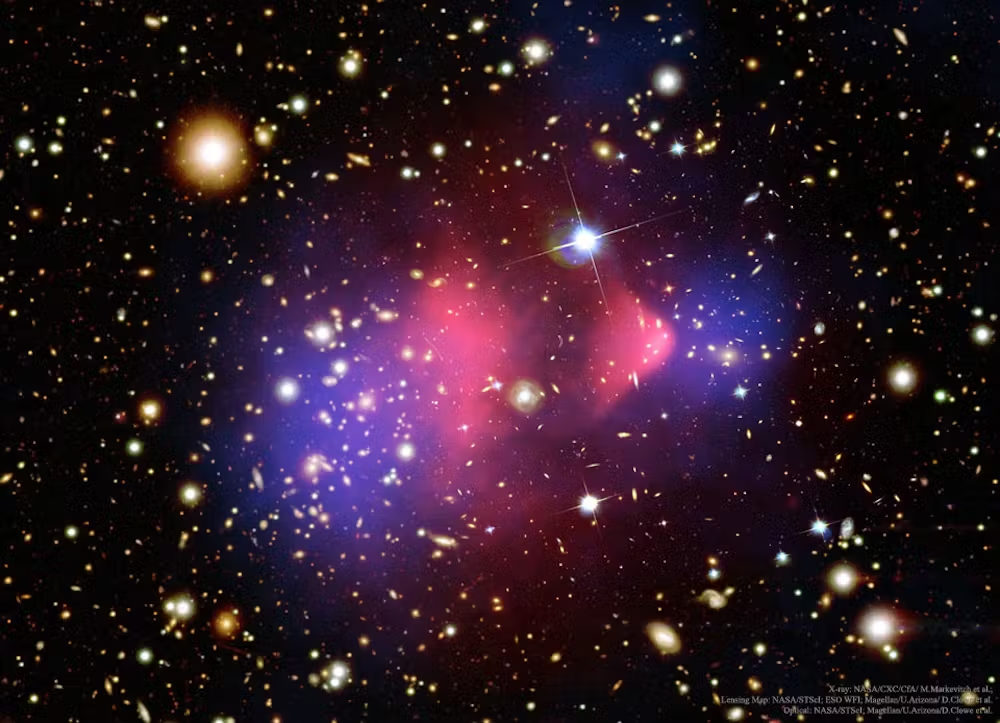
For decades, scientists have been on a quest to uncover the mysterious particles that compose dark matter. One of the most promising candidates is the axion, an elusive particle that could transform our understanding of the universe. While axions remain hypothetical, new research suggests that neutron stars—specifically pulsars with strong magnetic fields—could produce detectable amounts of axions, providing a potential way to finally observe them.
What Are Axions, and Why Are They Important?
Axions are elementary particles first proposed in the 1970s to solve issues related to particle physics, particularly in the field of quantum chromodynamics. Unlike more familiar particles like electrons or protons, axions are theorized to interact weakly with ordinary matter, making them difficult to detect. However, their properties make them a perfect candidate for dark matter, the invisible substance thought to make up roughly 85% of the universe’s matter.
Dark matter has perplexed scientists for years due to its gravitational effects on visible matter, yet it has evaded direct observation. Detecting axions could confirm one of the most significant theories in modern physics, helping us understand the makeup and evolution of the universe on a fundamental level.
Pulsars as Potential Sources of Axions
Pulsars, a type of neutron star, could be the key to unlocking the axion mystery. When large stars go supernova, they collapse into neutron stars, compressing mass comparable to the Sun into a sphere the size of a city. The resulting magnetic field around these stars is extraordinarily powerful—trillions of times stronger than Earth’s, creating an environment where axions might be produced in substantial quantities.
These pulsars are highly magnetized and rotate at extreme speeds, sometimes completing a full rotation in milliseconds. According to researchers, this rapid spin intensifies the magnetic field, potentially leading to axion production. As these particles escape the neutron star, they encounter the magnetic field, which can cause them to transform into photons—particles of light—thus offering a faint yet detectable signal of their existence.
The Science Behind Axion Production in Neutron Stars
Researchers at the University of Amsterdam and other institutions have explored the physics behind axion production in neutron stars. The high-energy environment around neutron stars could create a process in which axions form and are trapped by the star’s gravity. Over time, these particles could accumulate into dense clouds around the star, forming a shroud of axions that persist for millions of years.
In theory, this cloud of axions would emit a low-intensity glow detectable by telescopes on Earth, allowing scientists to observe indirect evidence of axions. The researchers outline two primary detection methods: first, looking for a continuous radio signal around neutron stars, which could correspond to the mass of the axion, and second, detecting bursts of light that may appear when a neutron star stops emitting radiation near the end of its life.
Observational Challenges and Recent Findings
Observing axions is challenging due to their weak interactions with regular matter, which is why they’ve remained undetected despite decades of research. Even with advanced telescopes, astronomers have not yet observed axions directly. However, the latest research provides a refined approach by establishing tighter constraints on axion properties based on neutron star observations.
For instance, in studying nearby pulsars, scientists found no excess light that would suggest the presence of axions. While this might seem like a setback, it has allowed researchers to place limits on the possible mass and interaction strength of axions, refining the search parameters for future studies.
Why This Matters for Dark Matter and Cosmology
The potential discovery of axions would have profound implications beyond just dark matter. In cosmology, understanding dark matter is crucial for explaining the universe’s structure and behavior. Dark matter influences galaxy formation, gravitational interactions, and the expansion of the universe, yet its elusive nature has left a gap in our knowledge.
If axions do exist, they would contribute significantly to our understanding of dark matter, allowing scientists to model the universe more accurately. Additionally, detecting axions around neutron stars could open the door to understanding other exotic particles and interactions that might influence cosmic evolution.
Future Directions and Technological Innovations
With the groundwork laid by current research, the focus now turns to the future. Advances in telescope technology, such as the Square Kilometre Array (SKA) and next-generation X-ray observatories, will enhance our ability to detect faint signals from neutron stars. These telescopes will allow for more precise observations of potential axion clouds, enabling astronomers to test various hypotheses about dark matter.
Another promising avenue is the use of “axion haloscopes,” specialized instruments designed to detect axions through their interactions with strong magnetic fields. By creating controlled magnetic environments, scientists could simulate the conditions around neutron stars and observe the resulting signals, further refining the search for axions.
The Broader Impact: Connecting Particle Physics and Astrophysics
The hunt for axions represents a convergence of particle physics and astrophysics, illustrating how advances in one field can drive progress in another. While particle accelerators like the Large Hadron Collider have been instrumental in discovering particles like the Higgs boson, the search for axions necessitates a different approach. Astrophysical observations provide a natural laboratory for studying particles in extreme conditions that are difficult, if not impossible, to replicate on Earth.
This interdisciplinary approach holds promise not only for understanding dark matter but also for unlocking new realms of physics. By observing axions, scientists could validate theories about symmetry in fundamental forces, potentially reshaping our understanding of the universe’s underlying principles.
Conclusion
The pursuit of axions is more than a search for an elusive particle—it’s a quest to solve one of the universe’s deepest mysteries. Neutron stars, with their immense magnetic fields and extreme environments, offer a unique opportunity to detect axions and probe the nature of dark matter. While the journey is far from over, recent research brings us closer to a discovery that could redefine our understanding of the cosmos.
Reference:
Noordhuis, D., Prabhu, A., Weniger, C., & Witte, S. J. (2024). Axion clouds around neutron stars. Physical Review X, 14(041015)


