
• Latest
  • Trending
  • All
WOH G64

You Have to See This First Close-Up of a Star’s Chaotic End!

November 23, 2024
3D-visualization-of-soliton-knots-in-energy-fields-solving-problem-of-matter-asymmetry-through-Peccei-Quinn-symmetry-mechanisms

Problem of Matter Asymmetry : New Physics Solution Proposed

December 4, 2025
Stardust Found in NASA Bennu Samples: Life’s Molecular Origins Revealed

Stardust Found in NASA Bennu Samples: Life’s Molecular Origins Revealed

December 4, 2025
ADVERTISEMENT
Artist's depiction of futuristic Martian base showing how astronauts could build houses on Mars using sustainable bacterial technology

Build Houses on Mars With Bacteria: Revolutionary Settlement Technology

December 4, 2025
Turn Space Debris Into Future Spacecraft

Turn Space Debris Into Future Spacecraft – Circular Economy Concept

December 3, 2025
Rare Open Cluster Association – PHR J1724-3859 Connected to Trumpler 25

Rare Open Cluster Association – PHR J1724-3859 Connected to Trumpler 25

December 3, 2025
JWST find an exomoon

JWST Find an Exomoon: Sunspot Mimics Moon Signal in New Study

December 3, 2025
Cosmic Halo Spin : Dark Matter-Dark Energy Interaction Shapes Structure

Cosmic Halo Spin : Dark Matter-Dark Energy Interaction Shapes Structure

December 2, 2025
Moon rocks reveal stunning clues

Moon Rocks Reveal Stunning Clues About Theia’s Missing Planet

December 2, 2025
search for habitable worlds

Search for Habitable Worlds – New Tectonic Framework Discovered

December 2, 2025
Water Retention on Earth-Like Planets : Variable Stars Study Results

Water Retention on Earth-Like Planets : Variable Stars Study Results

December 1, 2025
Tiny Red Dot in Deep Space : New Cosmic Monster Discovered

Tiny Red Dot in Deep Space : New Cosmic Monster Discovered

December 1, 2025
Local space weather

Local Space Weather Impacts Vary More Than Expected Across Regions

December 1, 2025
ADVERTISEMENT
NASA Space News
No Result
View All Result
  • Home
  • Missions
    SIMP-0136 weather report

    SIMP-0136 Weather Report Reveals Storms and Auroras on a Rogue World

    Moon-forming disk

    JWST Reveals the Chemistry Inside a Moon-forming disk

    Little Red Dots

    Are the “Little Red Dots” Really Black Hole Stars? What JWST Is Revealing About the Early Universe

    Pismis 24 Star Cluster

    Inside the Lobster Nebula: Pismis 24 Star Cluster Unveiled

    Comet Lemmon

    A Rare Cosmic Visitor: Will Comet Lemmon Light Up October Sky?

    Butterfly Star

    The Butterfly Star: How James Webb New Discovery Unlocks Secrets of Planet Formation

    James Webb Space Telescope

    A Cosmic Masterpiece: James Webb Space Telescope Reveals the Heart of a Stellar Nursery

    interstellar comet

    A Cosmic Visitor Lights Up Our Solar System: The Story of Interstellar Comet 3I/ATLAS

    Interstellar comet 3I/ATLAS

    How TESS Spotted the Interstellar Comet 3I/ATLAS Early—and What It Means for Science

  • Planets
  • Astrophysics
  • Technology
  • Research
  • About
  • Contact Us
NASA Space News
No Result
View All Result
ADVERTISEMENT
Home Astronomy

You Have to See This First Close-Up of a Star’s Chaotic End!

by nasaspacenews
November 23, 2024
in Astronomy, Astrophysics, Cosmology, News, Others, stars
0
WOH G64

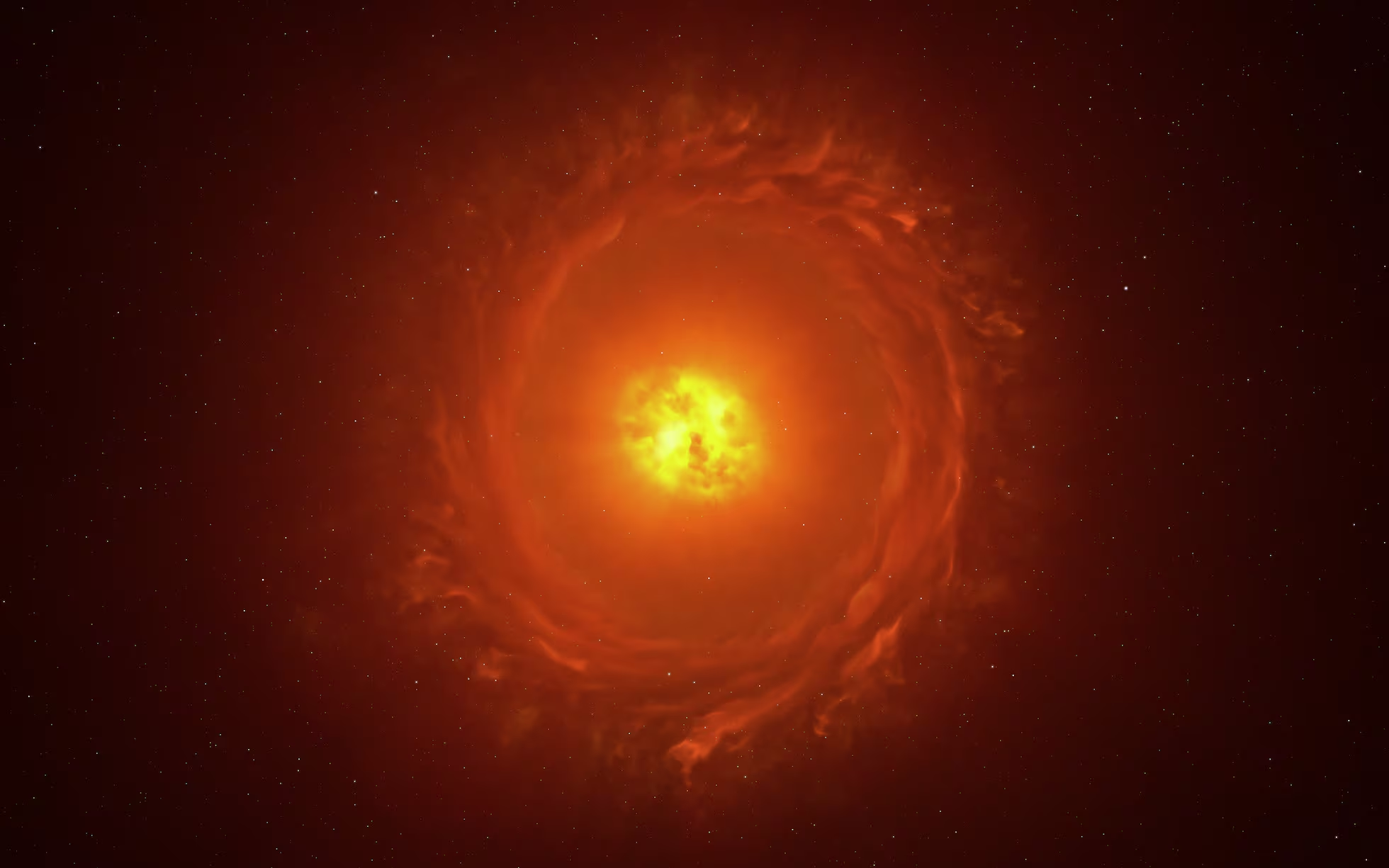
Artistic reconstruction of WOH G64, the first star outside our galaxy photographed in close-up. ESO/L. Calçada

ADVERTISEMENT
Share on FacebookShare on Twitter

160,000 light-years away in the Large Magellanic Cloud, a red supergiant named WOH G64 is nearing the end of its life in a spectacular cosmic display. Captured by the Very Large Telescope (VLT) using groundbreaking techniques, this first high-resolution image of a dying star outside the Milky Way is reshaping how scientists study the lifecycle of stars.

Table of Contents

Toggle
  • WOH G64: A Red Supergiant on the Brink of Collapse
  • How the Image Was Captured: A Technological Marvel
  • Surprising Findings: WOH G64 Defies Expectations
  • The Fate of WOH G64: Four Dramatic Scenarios
  • Why This Discovery Matters
  • What Lies Ahead for Astronomers?
  • Conclusion

WOH G64: A Red Supergiant on the Brink of Collapse

WOH G64 is no ordinary star. It is 2,000 times the size of our Sun, making it one of the largest known red supergiants. Located in the Large Magellanic Cloud, a satellite galaxy of the Milky Way, this colossal star has been the subject of astronomical curiosity for decades. Its behavior over the last ten years has been erratic, as it has begun expelling massive amounts of gas and dust in a chaotic manner.

The star’s final stages of life suggest that it is approaching a dramatic supernova explosion. Such an event, one of the most energetic in the universe, briefly releases an immense burst of light and energy before the star collapses into a neutron star or black hole. For astronomers, witnessing this process in a star outside our galaxy is an unparalleled opportunity to understand the end-of-life stages of massive stars.

How the Image Was Captured: A Technological Marvel
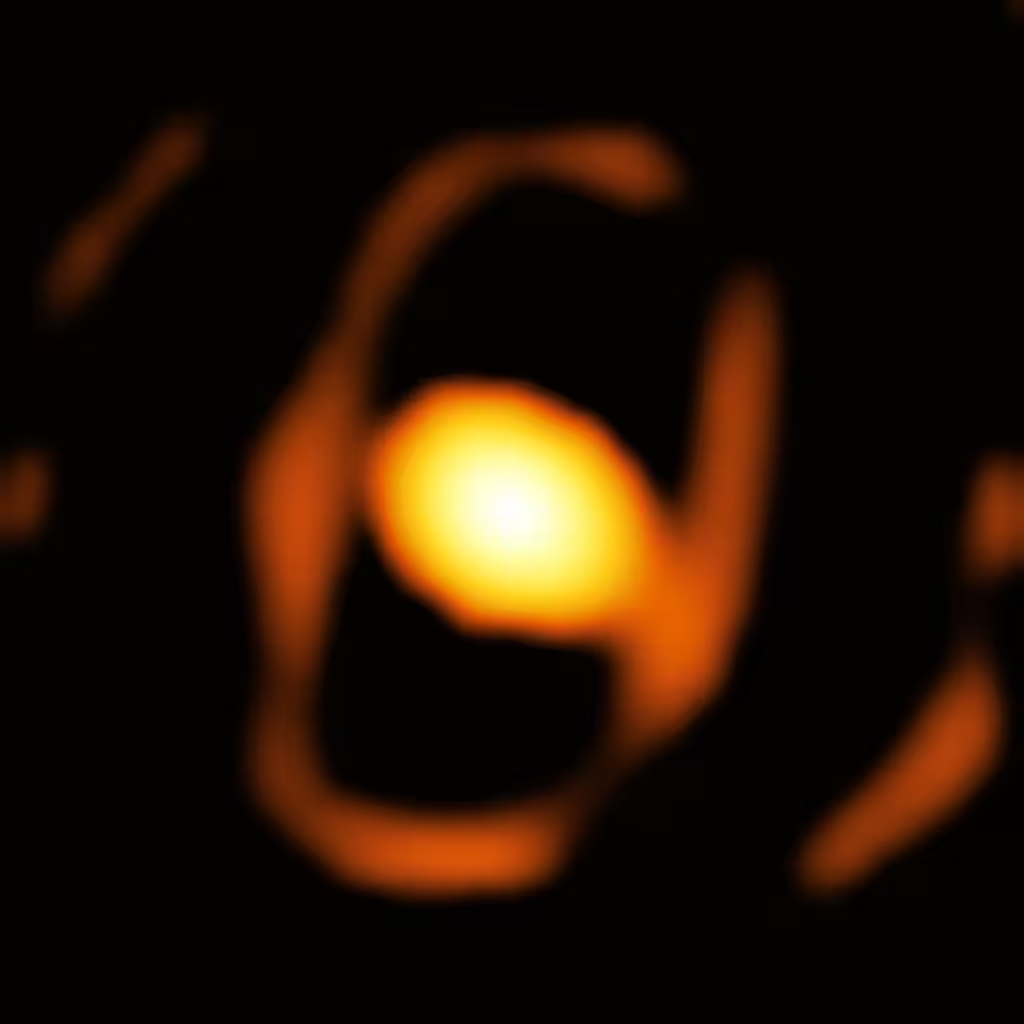
Photograph of the star WOH G64, 160,000 light-years from Earth, taken by the Very Large Telescope of the European Southern Observatory.ESO/K. Ohnaka et al.

WOH G64’s distance and size make capturing detailed images of it an extraordinary challenge. Astronomers faced a dilemma: with current technology, a single telescope capable of capturing such detail would need a 100-meter-wide lens, which is impossible to build with current engineering capabilities. The solution lay in innovation.

Using the VLT’s GRAVITY instrument, scientists combined the power of four 1.8-meter telescopes to act as one. This technique, known as interferometry, merged the light collected by each telescope, effectively creating a “virtual telescope” with unprecedented resolution. The combined effort resulted in a level of detail that was previously unattainable for stars beyond our galaxy.

Surprising Findings: WOH G64 Defies Expectations

When astronomers analyzed the image of WOH G64, they found a structure that defied conventional expectations. Instead of a symmetrical, bubble-like shape typical of red supergiants, the star appeared to be surrounded by an oval accumulation of light. This strange, egg-shaped structure is believed to result from the star’s expulsion of gas and dust into space.

The irregularity suggests that WOH G64 is undergoing an unusually intense period of instability. According to lead researcher Keiichi Ohnaka, the star’s ejection of matter has increased significantly over the past decade, creating the distinctive oval shape. Such behavior is atypical for red supergiants, whose material is usually expelled in a more symmetrical, geometric manner.

What causes this deviation? One possibility is that WOH G64’s outer atmosphere has become increasingly unstable, leading to uneven ejections of material. Another hypothesis suggests that a hidden companion star may be influencing the supergiant’s behavior. If this companion exists, its gravitational pull could be shaping the ejected material into the observed oval pattern.

The findings challenge existing models of stellar evolution, pushing astronomers to refine their understanding of how massive stars behave during their final stages of life.

The Fate of WOH G64: Four Dramatic Scenarios

As WOH G64 approaches the end of its life, it faces several possible fates, each dramatic and transformative.

  1. Planetary Nebula Formation
    WOH G64 may shed its outer layers gradually, forming a planetary nebula—a glowing shell of ionized gas. This is a common fate for stars that exhaust their nuclear fuel, leaving behind a dense core.
  2. Transition to a Blue Supergiant
    The star could increase in temperature, transforming into a blue supergiant. This final, short-lived phase often precedes a supernova explosion, marking the star’s ultimate demise.
  3. Collapse into a Black Hole
    If WOH G64 is massive enough, it could bypass the supernova stage entirely, collapsing directly into a black hole. Such an outcome would offer valuable insights into the formation of black holes.
  4. Supernova Explosion
    The most spectacular possibility is a supernova explosion. This event would briefly outshine an entire galaxy, releasing elements like oxygen, carbon, and iron into space—key ingredients for forming planets and life.

Why This Discovery Matters

First, studying WOH G64 offers insights into the chemical enrichment of the universe. Massive stars like WOH G64 play a crucial role in creating and distributing heavy elements such as carbon, oxygen, and iron. When these stars die, they seed the surrounding space with these elements, fueling the formation of new stars, planets, and potentially life.

Second, the discovery provides a rare opportunity to observe stellar evolution in real time. Most changes in stars occur over millions of years, making it difficult to study these processes within a human lifetime. The rapid changes in WOH G64’s behavior offer a unique glimpse into the dynamic and often violent nature of massive stars.

Third, the findings challenge and refine existing models of stellar evolution. The irregular behavior of WOH G64 suggests that our understanding of red supergiants and their end-of-life stages is incomplete. This discovery will likely prompt further research into the factors that influence the behavior of massive stars.

Finally, the success of the VLT’s GRAVITY instrument demonstrates the power of collaborative efforts and technological innovation in astronomy. By combining the capabilities of multiple telescopes, researchers have pushed the boundaries of what is possible, paving the way for future studies of distant stars and galaxies.

What Lies Ahead for Astronomers?

The study of WOH G64 is far from over. Future observations will be crucial in determining the star’s ultimate fate. Advanced instruments like the James Webb Space Telescope (JWST) could provide even more detailed insights into the structure and composition of the star and its surroundings.

ADVERTISEMENT

Researchers also hope to identify other massive dying stars in the Large Magellanic Cloud and beyond. Comparing these stars to WOH G64 will help scientists develop a more comprehensive understanding of how massive stars evolve and die.

Conclusion

The first high-resolution image of WOH G64 marks a significant milestone in the study of stellar evolution. This dying red supergiant, with its chaotic expulsion of matter and unique egg-shaped structure, offers an unprecedented glimpse into the final moments of a massive star’s life.

By pushing the limits of technology and combining the power of multiple telescopes, astronomers have not only captured a stunning image but also opened new avenues for exploring the universe’s most extreme phenomena.

Reference:

Imaging the innermost circumstellar environment of the red supergiant WOH G64 in the Large Magellanic Cloud

K. Ohnaka, K.-H. Hofmann, G. Weigelt, J. Th. van Loon, D. Schertl and S. R. Goldman

Tags: astronomy newsastrophysicscosmic dust ejectioncosmic phenomenadying starEuropean Southern Observatoryhigh-resolution star imageinterstellar eventsLarge Magellanic Cloudred supergiantspace discoveryspace sciencestar explosionstar formationstellar deathstellar evolutionsupernovaVery Large TelescopeWOH G64

FEATURED POST

3D-visualization-of-soliton-knots-in-energy-fields-solving-problem-of-matter-asymmetry-through-Peccei-Quinn-symmetry-mechanisms

Problem of Matter Asymmetry : New Physics Solution Proposed

December 4, 2025
Stardust Found in NASA Bennu Samples: Life’s Molecular Origins Revealed

Stardust Found in NASA Bennu Samples: Life’s Molecular Origins Revealed

December 4, 2025
Artist's depiction of futuristic Martian base showing how astronauts could build houses on Mars using sustainable bacterial technology

Build Houses on Mars With Bacteria: Revolutionary Settlement Technology

December 4, 2025
Turn Space Debris Into Future Spacecraft

Turn Space Debris Into Future Spacecraft – Circular Economy Concept

December 3, 2025

EDITOR PICK'S

Problem of Matter Asymmetry : New Physics Solution Proposed

December 4, 2025

Stardust Found in NASA Bennu Samples: Life’s Molecular Origins Revealed

December 4, 2025

Build Houses on Mars With Bacteria: Revolutionary Settlement Technology

December 4, 2025

Turn Space Debris Into Future Spacecraft – Circular Economy Concept

December 3, 2025

Rare Open Cluster Association – PHR J1724-3859 Connected to Trumpler 25

December 3, 2025

JWST Find an Exomoon: Sunspot Mimics Moon Signal in New Study

December 3, 2025

Cosmic Halo Spin : Dark Matter-Dark Energy Interaction Shapes Structure

December 2, 2025

STAY CONNECTED

Recent News

3D-visualization-of-soliton-knots-in-energy-fields-solving-problem-of-matter-asymmetry-through-Peccei-Quinn-symmetry-mechanisms

Problem of Matter Asymmetry : New Physics Solution Proposed

December 4, 2025
Stardust Found in NASA Bennu Samples: Life’s Molecular Origins Revealed

Stardust Found in NASA Bennu Samples: Life’s Molecular Origins Revealed

December 4, 2025

Category

  • Asteroid
  • Astrobiology
  • Astrology
  • Astronomy
  • Astrophotography
  • Astrophysics
  • Auroras
  • Black holes
  • Comets
  • Cosmology
  • Dark energy
  • Dark Matter
  • Earth
  • Euclid
  • Exoplanets
  • Galaxies
  • Jupiter
  • JWST
  • Mars
  • Mercury
  • Meteor showers
  • Missions
  • Moon
  • Neptune
  • News
  • Others
  • Planets
  • QuantumPhysics
  • quasars
  • Research
  • Rocks
  • Saturn
  • solar storm
  • Solar System
  • stars
  • sun
  • Technology
  • Universe
  • Uranus
  • Venus
  • Voyager

We bring you the latest news and updates in space exploration, innovation, and astronomy.

  • ABOUT US
  • CONTACT US
  • DISCLAIMER
  • PRIVACY POLICY
  • Terms of Service

© 2025 NASA Space News

No Result
View All Result
  • Home
  • Missions
  • Planets
  • Astrophysics
  • Technology
  • Research
  • About
  • Contact Us

© 2025 NASA Space News

Welcome Back!

Sign In with Facebook
Sign In with Google
Sign In with Linked In
OR

Login to your account below

Forgotten Password?

Retrieve your password

Please enter your username or email address to reset your password.

Log In

Add New Playlist