
• Latest
  • Trending
  • All
An artist's rendition of Kepler-186f, an Earth-like exoplanet that astronomers now believe has a stable axial tilt, giving it regular seasons and a comfortable climateNASA Ames/JPL-Caltech/T. Pyle

Two Earth-Like Planets Found Close to Home – Are They Habitable?

December 25, 2024
Is the Universe slowing down?

Is the Universe Slowing Down? New Evidence Suggests Deceleration

November 13, 2025
Life in the clouds on other worlds

Life in the clouds on other worlds: New Biosignature Detection Method

November 13, 2025
ADVERTISEMENT
what happens on Mars today

What Happens on Mars Today: Dust Avalanches Move Quarter Annual Dust

November 13, 2025
Strongest solar flare of 2025

Sun Unleashes Strongest Solar Flare of 2025 From Sunspot AR4274

November 12, 2025
Habitable worlds in the universe

More habitable worlds in the universe: Planets make their own water

November 12, 2025
Oldest Stars Are Planet Killers

Oldest Stars Are Planet Killers: Aging Stars Destroy Close Planets

November 12, 2025
After the Big Bang: Exotic Objects Formed Within First Second

After the Big Bang: Exotic Objects Formed Within First Second

November 11, 2025
the Milky Way’s Dark Heart

The Milky Way’s Dark Heart Shaped Like a Box, New Simulations Show

November 11, 2025
Maneuverable Satellite Bus

Maneuverable Satellite Bus: Portal Starburst Launches Late 2026 on Transporter-18

November 11, 2025
The 'anti-weather' of Venus

The ‘Anti-Weather’ of Venus: Regional Wind and Dust Transport Modeling

November 10, 2025
Tianwen-1 orbiter spots 3I ATLAS

Tianwen-1 Orbiter Spots 3I/ATLAS: Historic Interstellar Comet Observation

November 10, 2025
Debate on Dark Matter

Debate on Dark Matter Resolved: Dwarf Galaxies Prove Invisible Matter

November 10, 2025
ADVERTISEMENT
NASA Space News
No Result
View All Result
  • Home
  • Missions
    SIMP-0136 weather report

    SIMP-0136 Weather Report Reveals Storms and Auroras on a Rogue World

    Moon-forming disk

    JWST Reveals the Chemistry Inside a Moon-forming disk

    Little Red Dots

    Are the “Little Red Dots” Really Black Hole Stars? What JWST Is Revealing About the Early Universe

    Pismis 24 Star Cluster

    Inside the Lobster Nebula: Pismis 24 Star Cluster Unveiled

    Comet Lemmon

    A Rare Cosmic Visitor: Will Comet Lemmon Light Up October Sky?

    Butterfly Star

    The Butterfly Star: How James Webb New Discovery Unlocks Secrets of Planet Formation

    James Webb Space Telescope

    A Cosmic Masterpiece: James Webb Space Telescope Reveals the Heart of a Stellar Nursery

    interstellar comet

    A Cosmic Visitor Lights Up Our Solar System: The Story of Interstellar Comet 3I/ATLAS

    Interstellar comet 3I/ATLAS

    How TESS Spotted the Interstellar Comet 3I/ATLAS Early—and What It Means for Science

  • Planets
  • Astrophysics
  • Technology
  • Research
  • About
  • Contact Us
NASA Space News
No Result
View All Result
ADVERTISEMENT
Home Astronomy

Two Earth-Like Planets Found Close to Home – Are They Habitable?

by nasaspacenews
December 25, 2024
in Astronomy, Earth, Exoplanets, News, Others
0
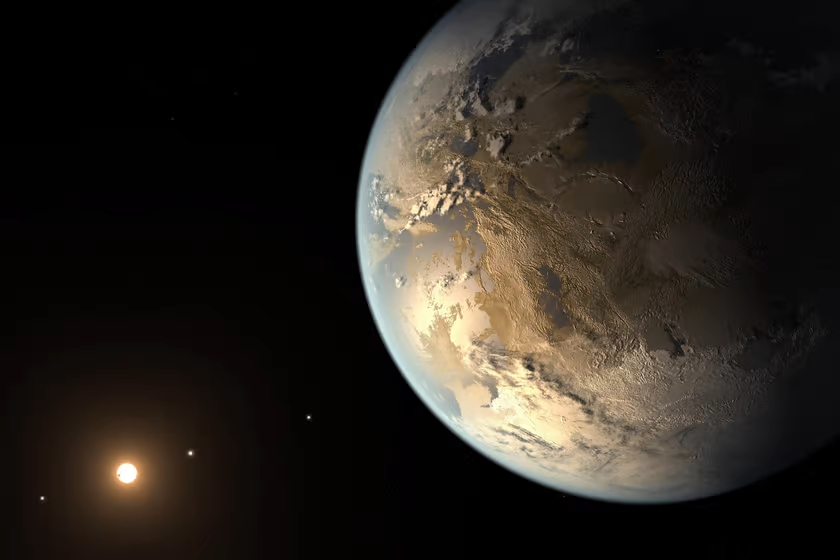
An artist's rendition of Kepler-186f, an Earth-like exoplanet that astronomers now believe has a stable axial tilt, giving it regular seasons and a comfortable climateNASA Ames/JPL-Caltech/T. Pyle

NASA Ames/JPL-Caltech/T. Pyle

ADVERTISEMENT
Share on FacebookShare on Twitter


Astronomers have unveiled a groundbreaking discovery in the search for alien worlds, as NASA’s Transiting Exoplanet Survey Satellite (TESS) has confirmed two Earth-sized planets orbiting a nearby star known as HD 101581.

Table of Contents

Toggle
  • A Remarkable Discovery: HD 101581 b and c
  • The Host Star: HD 101581
  • The Science Behind the Discovery
  • Future Directions in Exoplanet Research
  • What We Learn from HD 101581
  • Conclusion

A Remarkable Discovery: HD 101581 b and c

Two exoplanets, designated HD 101581 b and HD 101581 c, were detected orbiting a nearby star using data from TESS, followed by ground-based observations. These planets are slightly smaller than Earth, making them unique additions to the growing catalog of exoplanets.

HD 101581 b, the closer of the two planets, has a radius of 0.956 Earth radii and completes an orbit around its star in just 4.47 days. Its calculated equilibrium temperature is a scorching 834 K (561°C), indicating its close proximity to the star. HD 101581 c, slightly larger at 0.99 Earth radii, has a longer orbital period of 6.21 days and an equilibrium temperature of 747 K (474°C).

These findings suggest that both planets are far too hot to host life as we know it. Evidence for a potential third planet, which would have a radius of about 0.98 Earth radii and an orbital period of 7.87 days, adds another layer of intrigue to this system. If confirmed, this would position HD 101581 as a host to multiple Earth-sized worlds, a rare occurrence among known planetary systems.

The Host Star: HD 101581

At the heart of this discovery is HD 101581, a K-dwarf star located just 41.7 light-years away from Earth. This star, with a radius of 0.63 times that of the Sun and a mass of approximately 0.74 solar masses, represents an ideal target for exoplanetary studies.

Its brightness and proximity enable precise observations of its planets’ transit signals. HD 101581’s age, estimated at 7 billion years, combined with its cooler temperature of 4,634 K, suggests a stable environment where planetary systems can form and evolve. The discovery of multiple Earth-sized planets around such a star provides valuable insights into the dynamics and formation processes of compact planetary systems.

The Science Behind the Discovery

The detection of HD 101581 b and c was made possible through the combined efforts of TESS and ground-based telescopes. TESS, launched in 2018, surveys the brightest stars near the Sun to detect dips in their brightness caused by planets transiting across their surfaces. For HD 101581, these transit signals were identified in data from TESS sectors 63 and 64.

Follow-Up Observations
Ground-based telescopes were used to confirm the planetary nature of the transit signals. These observations provided critical data on the planets’ masses, radii, and orbital periods. Together, these findings paint a detailed picture of the HD 101581 system.

Advanced Techniques
State-of-the-art techniques, such as light curve analysis, allowed astronomers to detect the subtle signals of these small planets. This achievement highlights the growing precision of exoplanet detection methods and their ability to uncover worlds that were previously beyond our reach.

ADVERTISEMENT

Future Directions in Exoplanet Research

The HD 101581 system opens the door to exciting possibilities for future research. Scientists are eager to explore these planets in greater detail, particularly their atmospheres and compositions.

1. Atmospheric Studies with JWST
The James Webb Space Telescope could be used to search for atmospheric signatures on these planets. By analyzing their spectra during transits, astronomers can identify gases and other compounds in their atmospheres, providing clues about their formation and evolution.

2. Confirmation of the Third Planet
The suspected third planet in the system, if confirmed, would further enhance the significance of this discovery. Understanding its properties could reveal new insights into the architecture of compact planetary systems.

3. Broader Implications
Studying HD 101581 and its planets contributes to the larger effort to map the diversity of planetary systems in our galaxy. Comparing these findings with other systems could reveal patterns and anomalies that deepen our understanding of planetary formation.

What We Learn from HD 101581

This discovery reinforces the idea that planetary systems can take on a wide variety of forms. While HD 101581’s planets are unlikely to host life, they provide valuable data about the range of conditions under which planets can form and persist.

By studying these extreme environments, scientists can refine their models and predictions for other planetary systems, including those that may harbor life. Moreover, the proximity and brightness of HD 101581 make it an invaluable target for continued study. As telescopes become more powerful, our ability to analyze such systems will only improve, leading to new breakthroughs and discoveries.

Conclusion

The discovery of two Earth-sized exoplanets orbiting HD 101581 represents a major milestone in exoplanet research. These planets, among the smallest yet found around a nearby star, offer a unique opportunity to study the dynamics and characteristics of compact planetary systems.

Reference:

Michelle Kunimoto et al, Two Earth-size Planets and an Earth-size Candidate Transiting the Nearby Star HD 101581, arXiv (2024).

Tags: alien worldsastronomy newsEarth-sized planetsExoplanet DiscoveryExoplanetshabitable planetshabitable zoneHD 101581life beyond EarthNASA TESSnearby solar systemsnearby starplanet detectionplanetary orbitsPlanetary Sciencesmall planetsspace discoveriesspace explorationstar HD 101581TESS discovery

FEATURED POST

Is the Universe slowing down?

Is the Universe Slowing Down? New Evidence Suggests Deceleration

November 13, 2025
Life in the clouds on other worlds

Life in the clouds on other worlds: New Biosignature Detection Method

November 13, 2025
what happens on Mars today

What Happens on Mars Today: Dust Avalanches Move Quarter Annual Dust

November 13, 2025
Strongest solar flare of 2025

Sun Unleashes Strongest Solar Flare of 2025 From Sunspot AR4274

November 12, 2025

EDITOR PICK'S

Is the Universe Slowing Down? New Evidence Suggests Deceleration

November 13, 2025

Life in the clouds on other worlds: New Biosignature Detection Method

November 13, 2025

What Happens on Mars Today: Dust Avalanches Move Quarter Annual Dust

November 13, 2025

Sun Unleashes Strongest Solar Flare of 2025 From Sunspot AR4274

November 12, 2025

More habitable worlds in the universe: Planets make their own water

November 12, 2025

Oldest Stars Are Planet Killers: Aging Stars Destroy Close Planets

November 12, 2025

After the Big Bang: Exotic Objects Formed Within First Second

November 11, 2025

STAY CONNECTED

Recent News

Is the Universe slowing down?

Is the Universe Slowing Down? New Evidence Suggests Deceleration

November 13, 2025
Life in the clouds on other worlds

Life in the clouds on other worlds: New Biosignature Detection Method

November 13, 2025

Category

  • Asteroid
  • Astrobiology
  • Astrology
  • Astronomy
  • Astrophotography
  • Astrophysics
  • Auroras
  • Black holes
  • Comets
  • Cosmology
  • Dark energy
  • Dark Matter
  • Earth
  • Euclid
  • Exoplanets
  • Galaxies
  • Jupiter
  • JWST
  • Mars
  • Mercury
  • Meteor showers
  • Missions
  • Moon
  • Neptune
  • News
  • Others
  • Planets
  • QuantumPhysics
  • quasars
  • Research
  • Rocks
  • Saturn
  • solar storm
  • Solar System
  • stars
  • sun
  • Technology
  • Universe
  • Uranus
  • Venus
  • Voyager

We bring you the latest news and updates in space exploration, innovation, and astronomy.

  • ABOUT US
  • CONTACT US
  • DISCLAIMER
  • PRIVACY POLICY
  • Terms of Service

© 2025 NASA Space News

No Result
View All Result
  • Home
  • Missions
  • Planets
  • Astrophysics
  • Technology
  • Research
  • About
  • Contact Us

© 2025 NASA Space News

Welcome Back!

Sign In with Facebook
Sign In with Google
Sign In with Linked In
OR

Login to your account below

Forgotten Password?

Retrieve your password

Please enter your username or email address to reset your password.

Log In

Add New Playlist