
• Latest
  • Trending
  • All
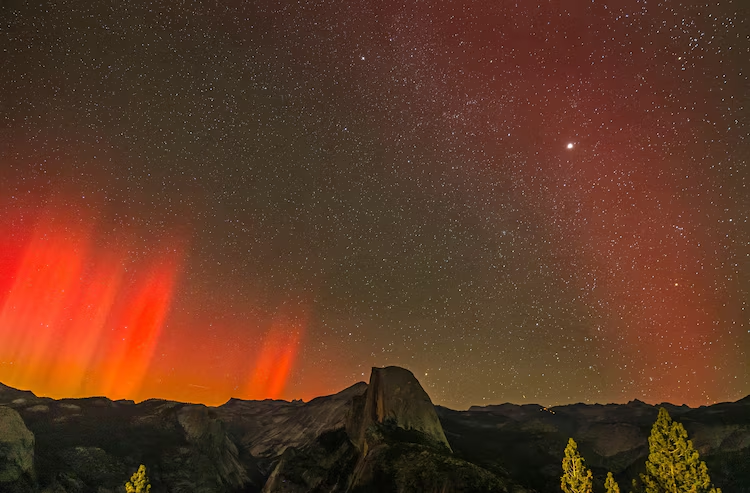
The northern lights over Half Dome in Yosemite National Park, Calif., Oct. 11, 2024. Carlos Avila Gonzalez/San Francisco Chronicle via Getty Images

Auroras Are Back! Where and When to Witness Nature’s Dazzling Display

January 25, 2025
packed with tiny galaxies

Packed With Tiny Galaxies: The Missing Dwarf Galaxies Mystery

January 15, 2026
act like cosmic seesaws

Act Like Cosmic Seesaws: Black Holes’ Self-Regulating Energy Mechanism

January 15, 2026
ADVERTISEMENT
mystery of blue flashes

Mystery of Blue Flashes: Solving Cosmic Explosions

January 15, 2026
massive solar engine

Massive Solar Engine Powers NASA’s Lunar Gateway Station

January 14, 2026
Hard to categorize objects

Hard to Categorize Objects: JWST’s Mysterious Galaxy Discovery

January 14, 2026
How cold is space

How Cold Is Space? Temperature Physics Explained

January 14, 2026
Mars is not just red

Mars Is Not Just Red – It’s Electrically Alive, Scientists Reveal

January 13, 2026
super earths are born

How Super Earths Are Born: V1298 System Reveals Planet Formation

January 13, 2026
new type of supernova

New Type of Supernova Discovered Through Artificial Intelligence Pattern Recognition

January 13, 2026
interstellar communication

Mathematics as Universal Language for Interstellar Communication With Aliens

January 12, 2026
Earth seeded the Moon

Earth Seeded the Moon With Atmospheric Particles for Billions of Years

January 12, 2026
common types of planets

Common Types of Planets Transform From Puffy Giants Into Super-Earths

January 12, 2026
NASA Space News
No Result
View All Result
  • Home
  • Missions
    SIMP-0136 weather report

    SIMP-0136 Weather Report Reveals Storms and Auroras on a Rogue World

    Moon-forming disk

    JWST Reveals the Chemistry Inside a Moon-forming disk

    Little Red Dots

    Are the “Little Red Dots” Really Black Hole Stars? What JWST Is Revealing About the Early Universe

    Pismis 24 Star Cluster

    Inside the Lobster Nebula: Pismis 24 Star Cluster Unveiled

    Comet Lemmon

    A Rare Cosmic Visitor: Will Comet Lemmon Light Up October Sky?

    Butterfly Star

    The Butterfly Star: How James Webb New Discovery Unlocks Secrets of Planet Formation

    James Webb Space Telescope

    A Cosmic Masterpiece: James Webb Space Telescope Reveals the Heart of a Stellar Nursery

    interstellar comet

    A Cosmic Visitor Lights Up Our Solar System: The Story of Interstellar Comet 3I/ATLAS

    Interstellar comet 3I/ATLAS

    How TESS Spotted the Interstellar Comet 3I/ATLAS Early—and What It Means for Science

  • Planets
  • Astrophysics
  • Technology
  • Research
  • About
  • Contact Us
NASA Space News
No Result
View All Result
Home Astronomy

Auroras Are Back! Where and When to Witness Nature’s Dazzling Display

by nasaspacenews
January 25, 2025
in Astronomy, Astrophotography, Auroras, Earth, News, Others
0
The northern lights over Half Dome in Yosemite National Park, Calif., Oct. 11, 2024. Carlos Avila Gonzalez/San Francisco Chronicle via Getty Images

The northern lights over Half Dome in Yosemite National Park, Calif., Oct. 11, 2024. Carlos Avila Gonzalez/San Francisco Chronicle via Getty Images

Share on FacebookShare on Twitter

The northern lights, or aurora borealis, are among nature’s most stunning displays, captivating skywatchers with their ethereal dance of colors. Thanks to a recent severe solar storm, this breathtaking phenomenon is now more visible in several parts of the United States.

Table of Contents

Toggle
  • The Science Behind the Northern Lights
  • The Recent Solar Storm: A Trigger for Enhanced Auroras
  • Where to See the Northern Lights
  • Tips for Enhancing Your Aurora Viewing Experience
  • The Cultural and Scientific Significance of the Northern Lights
  • Why This Event Is Unique
  • The Role of Technology in Aurora Observations
  • Conclusion

The Science Behind the Northern Lights

Auroras occur when charged particles from the sun interact with Earth’s magnetic field and atmosphere. The sun emits a constant stream of solar wind, a flow of charged particles, but during events like solar storms, this flow intensifies, releasing bursts of energy called coronal mass ejections (CMEs). When these high-energy particles collide with Earth’s magnetic field, they create a dazzling light show in the upper atmosphere.

During such interactions, atoms and molecules in Earth’s atmosphere become excited, releasing energy in the form of light. The result? Vibrant greens, reds, blues, and purples shimmering across the night sky. The specific colors depend on the types of gases involved—oxygen emits green and red hues, while nitrogen creates blue and purple tones.

The Recent Solar Storm: A Trigger for Enhanced Auroras

The solar storm that occurred earlier this week marked a significant increase in geomagnetic activity, earning a planetary K-index rating of 5 out of 9. This index measures the intensity of geomagnetic storms, and a level 5 storm is classified as “minor,” but still impactful enough to produce vivid auroras.

The sun is currently in its solar maximum phase, a period of heightened solar activity that occurs approximately every 11 years. During this phase, the sun produces more sunspots, solar flares, and CMEs, which in turn increase auroral activity. Experts predict this heightened activity will continue for several months, offering more opportunities to witness the northern lights.

Where to See the Northern Lights

For those eager to catch a glimpse of the auroras, certain U.S. states are prime viewing spots. Alaska, Washington, Idaho, Montana, North Dakota, and Minnesota are among the states with the highest chances of seeing the northern lights. Under optimal conditions, states like South Dakota, Wisconsin, and Maine might also catch a glimpse of this celestial phenomenon.

The best times to view the auroras are between 10 p.m. and 2 a.m. local time ,for the most accurate and up-to-date information on auroral activity, you can visit NOAA’s Aurora Dashboard, which provides real-time forecasts and visibility maps. You can access it here. However, visibility depends on factors like cloud cover, light pollution, and the strength of the auroral activity. Rural areas away from city lights offer the best vantage points. For those living in urban environments, a short drive to a darker location can make all the difference.

Tips for Enhancing Your Aurora Viewing Experience

To maximize your chances of seeing the northern lights, preparation is key. First, monitor aurora forecasts from reliable sources like the National Oceanic and Atmospheric Administration (NOAA) or apps like Aurorasaurus. These platforms provide real-time updates on auroral activity and visibility.

Finding a dark location is essential. Light pollution from cities or even a bright full moon can diminish the visibility of auroras. Aim to position yourself in a wide, open area with a clear view of the northern horizon. A rural field, mountain peak, or lakeside location can provide ideal conditions.

ADVERTISEMENT

Smartphone cameras, especially in night mode, are surprisingly effective at capturing the northern lights, even when they appear faint to the naked eye. Set your camera to a long exposure mode for better results. For enthusiasts with DSLR cameras, using a tripod and experimenting with exposure settings can yield stunning images.

The Cultural and Scientific Significance of the Northern Lights

The northern lights have fascinated humanity for centuries, inspiring myths, folklore, and scientific inquiry. Indigenous peoples in Arctic regions have long regarded auroras as spiritual phenomena, associating them with ancestral spirits or celestial battles. Today, they are a testament to the dynamic relationship between Earth and the sun, showcasing the beauty of our planet’s magnetosphere.

ADVERTISEMENT

Why This Event Is Unique

What makes this auroral event particularly special is its timing during the solar maximum. The increased frequency of CMEs provides a rare opportunity for skywatchers in lower latitudes to experience the northern lights. Typically confined to Arctic regions, auroras during strong solar storms can extend farther south, reaching states like Wisconsin and Pennsylvania.

The Role of Technology in Aurora Observations

Modern technology has revolutionized how we observe and understand the northern lights. Spacecraft like the Solar and Heliospheric Observatory (SOHO) and NOAA satellites monitor solar activity, providing early warnings of geomagnetic storms. Ground-based observatories equipped with high-resolution cameras capture detailed images of auroras, revealing their intricate patterns and dynamics.

One notable tool is SOHO’s LASCO instrument, which uses a disk to block the sun’s surface, enabling scientists to study faint details in the solar atmosphere. This instrument has been instrumental in discovering over 5,000 comets and observing solar phenomena that influence auroras.

Conclusion

The recent solar storm and its resulting auroras offer a stunning reminder of the sun’s power and beauty. For those fortunate enough to witness the northern lights, the experience is nothing short of magical—a dance of light connecting Earth to the cosmos. Whether you’re an experienced astronomer or a curious observer, this celestial event is an invitation to look up, wonder, and explore the universe’s endless possibilities.

Tags: aurora alertsaurora borealisaurora forecastaurora locationsaurora photographyaurora scienceaurora sightingsaurora timingaurora tipsaurora viewingaurora watchingauroral activityCelestial Phenomenageomagnetic activitynight sky eventsnorthern lightssolar flaressolar maximumsolar stormspace weather

FEATURED POST

packed with tiny galaxies

Packed With Tiny Galaxies: The Missing Dwarf Galaxies Mystery

January 15, 2026
act like cosmic seesaws

Act Like Cosmic Seesaws: Black Holes’ Self-Regulating Energy Mechanism

January 15, 2026
mystery of blue flashes

Mystery of Blue Flashes: Solving Cosmic Explosions

January 15, 2026
massive solar engine

Massive Solar Engine Powers NASA’s Lunar Gateway Station

January 14, 2026

EDITOR PICK'S

Packed With Tiny Galaxies: The Missing Dwarf Galaxies Mystery

January 15, 2026

Act Like Cosmic Seesaws: Black Holes’ Self-Regulating Energy Mechanism

January 15, 2026

Mystery of Blue Flashes: Solving Cosmic Explosions

January 15, 2026

Massive Solar Engine Powers NASA’s Lunar Gateway Station

January 14, 2026

Hard to Categorize Objects: JWST’s Mysterious Galaxy Discovery

January 14, 2026

How Cold Is Space? Temperature Physics Explained

January 14, 2026

Mars Is Not Just Red – It’s Electrically Alive, Scientists Reveal

January 13, 2026

STAY CONNECTED

Recent News

packed with tiny galaxies

Packed With Tiny Galaxies: The Missing Dwarf Galaxies Mystery

January 15, 2026
act like cosmic seesaws

Act Like Cosmic Seesaws: Black Holes’ Self-Regulating Energy Mechanism

January 15, 2026

Category

  • Asteroid
  • Astrobiology
  • Astrology
  • Astronomy
  • Astrophotography
  • Astrophysics
  • Auroras
  • Black holes
  • Comets
  • Cosmology
  • Dark energy
  • Dark Matter
  • Earth
  • Euclid
  • Exoplanets
  • Galaxies
  • Jupiter
  • JWST
  • Mars
  • Mercury
  • Meteor showers
  • Missions
  • Moon
  • Neptune
  • News
  • Others
  • Planets
  • QuantumPhysics
  • quasars
  • Research
  • Rocks
  • Saturn
  • solar storm
  • Solar System
  • stars
  • sun
  • Technology
  • Universe
  • Uranus
  • Venus
  • Voyager

We bring you the latest news and updates in space exploration, innovation, and astronomy.

  • ABOUT US
  • CONTACT US
  • DISCLAIMER
  • PRIVACY POLICY
  • Terms of Service

© 2025 NASA Space News

No Result
View All Result
  • Home
  • Missions
  • Planets
  • Astrophysics
  • Technology
  • Research
  • About
  • Contact Us

© 2025 NASA Space News

Welcome Back!

Sign In with Facebook
Sign In with Google
Sign In with Linked In
OR

Login to your account below

Forgotten Password?

Retrieve your password

Please enter your username or email address to reset your password.

Log In

Add New Playlist