
• Latest
  • Trending
  • All
This image provided by NSF's NOIRLab shows an artist's illustration of the largest radio jet ever found in the early Universe. (M. Garlick/NOIRLab/NSF/AURA via AP)AP

This Monster Jet in Space is the Biggest Ever Seen—And It’s Still Growing

February 9, 2025
3D-visualization-of-soliton-knots-in-energy-fields-solving-problem-of-matter-asymmetry-through-Peccei-Quinn-symmetry-mechanisms

Problem of Matter Asymmetry : New Physics Solution Proposed

December 4, 2025
Stardust Found in NASA Bennu Samples: Life’s Molecular Origins Revealed

Stardust Found in NASA Bennu Samples: Life’s Molecular Origins Revealed

December 4, 2025
ADVERTISEMENT
Artist's depiction of futuristic Martian base showing how astronauts could build houses on Mars using sustainable bacterial technology

Build Houses on Mars With Bacteria: Revolutionary Settlement Technology

December 4, 2025
Turn Space Debris Into Future Spacecraft

Turn Space Debris Into Future Spacecraft – Circular Economy Concept

December 3, 2025
Rare Open Cluster Association – PHR J1724-3859 Connected to Trumpler 25

Rare Open Cluster Association – PHR J1724-3859 Connected to Trumpler 25

December 3, 2025
JWST find an exomoon

JWST Find an Exomoon: Sunspot Mimics Moon Signal in New Study

December 3, 2025
Cosmic Halo Spin : Dark Matter-Dark Energy Interaction Shapes Structure

Cosmic Halo Spin : Dark Matter-Dark Energy Interaction Shapes Structure

December 2, 2025
Moon rocks reveal stunning clues

Moon Rocks Reveal Stunning Clues About Theia’s Missing Planet

December 2, 2025
search for habitable worlds

Search for Habitable Worlds – New Tectonic Framework Discovered

December 2, 2025
Water Retention on Earth-Like Planets : Variable Stars Study Results

Water Retention on Earth-Like Planets : Variable Stars Study Results

December 1, 2025
Tiny Red Dot in Deep Space : New Cosmic Monster Discovered

Tiny Red Dot in Deep Space : New Cosmic Monster Discovered

December 1, 2025
Local space weather

Local Space Weather Impacts Vary More Than Expected Across Regions

December 1, 2025
ADVERTISEMENT
NASA Space News
No Result
View All Result
  • Home
  • Missions
    SIMP-0136 weather report

    SIMP-0136 Weather Report Reveals Storms and Auroras on a Rogue World

    Moon-forming disk

    JWST Reveals the Chemistry Inside a Moon-forming disk

    Little Red Dots

    Are the “Little Red Dots” Really Black Hole Stars? What JWST Is Revealing About the Early Universe

    Pismis 24 Star Cluster

    Inside the Lobster Nebula: Pismis 24 Star Cluster Unveiled

    Comet Lemmon

    A Rare Cosmic Visitor: Will Comet Lemmon Light Up October Sky?

    Butterfly Star

    The Butterfly Star: How James Webb New Discovery Unlocks Secrets of Planet Formation

    James Webb Space Telescope

    A Cosmic Masterpiece: James Webb Space Telescope Reveals the Heart of a Stellar Nursery

    interstellar comet

    A Cosmic Visitor Lights Up Our Solar System: The Story of Interstellar Comet 3I/ATLAS

    Interstellar comet 3I/ATLAS

    How TESS Spotted the Interstellar Comet 3I/ATLAS Early—and What It Means for Science

  • Planets
  • Astrophysics
  • Technology
  • Research
  • About
  • Contact Us
NASA Space News
No Result
View All Result
ADVERTISEMENT
Home Astronomy

This Monster Jet in Space is the Biggest Ever Seen—And It’s Still Growing

by nasaspacenews
February 9, 2025
in Astronomy, Astrophysics, Black holes, Cosmology
0
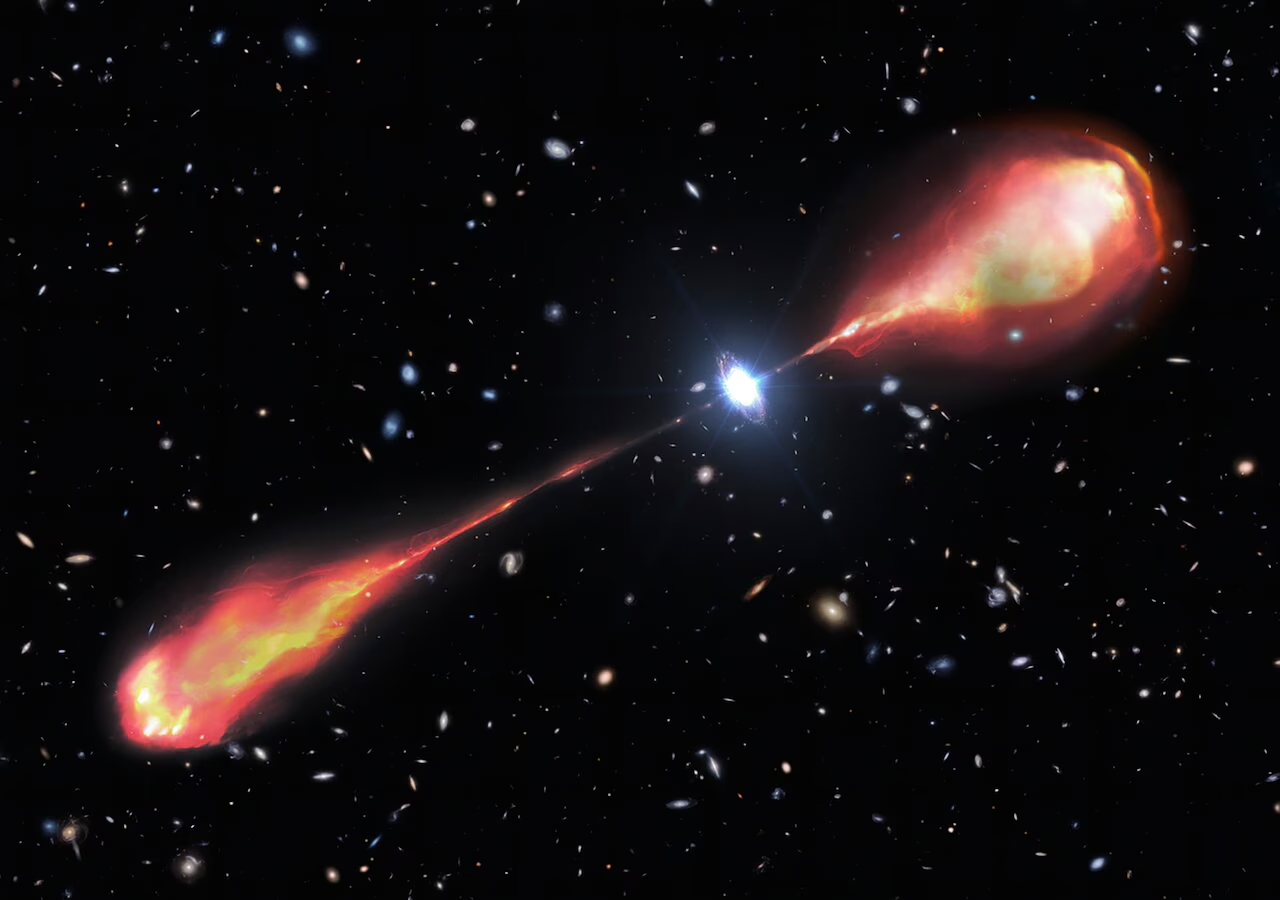
This image provided by NSF's NOIRLab shows an artist's illustration of the largest radio jet ever found in the early Universe. (M. Garlick/NOIRLab/NSF/AURA via AP)AP

This image provided by NSF's NOIRLab shows an artist's illustration of the largest radio jet ever found in the early Universe. (M. Garlick/NOIRLab/NSF/AURA via AP)AP

ADVERTISEMENT
Share on FacebookShare on Twitter

Astronomers have made an astonishing discovery: the largest radio jet ever observed in the early universe, spanning an incredible 200,000 light-years—double the width of our Milky Way galaxy. This colossal jet, streaming from a quasar known as J1601+3102, challenges our understanding of how supermassive black holes shaped the cosmos in its infancy.


Table of Contents

Toggle
    • A Cosmic Powerhouse in the Infant Universe
    • What Are Radio Jets, and Why Are They Important?
    • Combining Telescopes Across the Globe
    • Why Has It Taken So Long to Find a Jet This Big?
  • What Does This Mean for Our Understanding of the Universe?
    • Quasars Shaped the Early Universe
    • Solving the Mystery of Asymmetrical Jets
  • What Comes Next?
    • Future Missions Will Unlock More Secrets
  • Final Thoughts: A Window into the Past

A Cosmic Powerhouse in the Infant Universe

One of the most remarkable aspects of this discovery is its age. The quasar J1601+3102 formed when the universe was just 1.2 billion years old—less than 10% of its current age. At this early stage, astronomers did not expect to find such enormous radio jets, making this find one of the most extreme ever recorded.

Most known quasars are much brighter and more massive, with black holes billions of times the mass of our Sun. However, J1601+3102 is different. Despite its modest black hole mass of 450 million solar masses, it still produces an unbelievably large and powerful jet. The asymmetry in the two lobes of this jet suggests that the environment of the early universe influenced its structure, making this quasar an important piece of the cosmic puzzle.


What Are Radio Jets, and Why Are They Important?

Radio jets are narrow beams of relativistic particles, propelled outward by the extreme magnetic fields near a supermassive black hole. As matter falls into the black hole, some of it is ejected at incredible speeds, forming these massive structures that stretch for hundreds of thousands of light-years.

In modern galaxies, radio jets are known to regulate star formation by heating surrounding gas and preventing it from collapsing into new stars. This process, called feedback, plays a critical role in the evolution of galaxies. But in the early universe, it was unclear whether such processes were already in effect.


Combining Telescopes Across the Globe

Detecting such a faint, distant object is an enormous challenge. To study J1601+3102, astronomers combined data from multiple telescopes across different wavelengths:

  • The Low-Frequency Array (LOFAR) Telescope in Europe first detected the faint radio waves emitted by the jet.
  • The Gemini North Telescope in Hawaii captured near-infrared images, helping confirm the quasar’s distance and age.
  • The Hobby-Eberly Telescope in Texas provided optical spectroscopic data to measure the mass of the black hole.

This multi-wavelength approach allowed astronomers to see through the cosmic microwave background radiation—the relic heat of the Big Bang—enabling them to detect this enormous structure for the first time.


Why Has It Taken So Long to Find a Jet This Big?

The main reason we haven’t seen many radio jets in the early universe is that they fade over time. By the time their light reaches us, many of them have dimmed to the point of invisibility. Moreover, the cosmic microwave background—the afterglow of the Big Bang—makes it difficult to detect radio waves from such distant objects.

But J1601+3102 is so extreme that it stands out despite these challenges. This quasar’s jet is one of the brightest ever observed, making it a rare glimpse into the past and giving scientists a direct look at how galaxies evolved billions of years ago.

ADVERTISEMENT

What Does This Mean for Our Understanding of the Universe?

Quasars Shaped the Early Universe

Quasars like J1601+3102 are crucial in understanding the cosmic web—the large-scale structure of the universe. These powerful objects helped shape galaxies by expelling gas, heating intergalactic space, and regulating star formation.

This discovery challenges previous assumptions that such enormous jets formed much later in the universe’s timeline. Instead, it suggests that supermassive black holes were already influencing their surroundings long before scientists had predicted.

Solving the Mystery of Asymmetrical Jets

One of the strangest aspects of this radio jet is its asymmetry. The two lobes—massive structures at the end of the jet—appear uneven in both size and brightness. Scientists believe that external forces in the early universe—such as dense intergalactic gas or hidden magnetic fields—may have distorted the jet, causing one side to appear much brighter than the other.


What Comes Next?

Future Missions Will Unlock More Secrets

With modern technology improving at a rapid pace, this is just the beginning of what astronomers can uncover. Several upcoming missions will play a key role in advancing our understanding:

  • The Square Kilometer Array (SKA): Set to be the most sensitive radio telescope ever built, it will detect even fainter radio jets and uncover more quasars like J1601+3102.
  • The James Webb Space Telescope (JWST): Already revolutionizing astronomy, JWST will investigate the host galaxies of early quasars, providing insight into how these massive black holes formed.
  • The Extremely Large Telescope (ELT): This upcoming telescope will help astronomers examine the gas surrounding early quasars, shedding light on how they interact with their environments.

Final Thoughts: A Window into the Past

The discovery of J1601+3102’s record-breaking radio jet is a monumental step forward in understanding the early universe. This monstrous structure not only challenges existing theories but also opens the door to new possibilities about how supermassive black holes shaped the cosmos.

Reference:

Monster Radio Jet (>66 kpc) Observed in Quasar at z  ∼​​​​​ 5

Tags: astronomyastrophysicsBlack holescosmic evolutioncosmic jetscosmic structuresdeep spacedistant quasarsEarly Universeextragalactic scienceGalaxy formationhigh-energy astrophysicsintergalactic spaceObservational Astronomyquasarsradio astronomyspace explorationspace telescopesSupermassive Black Holesuniverse formation

FEATURED POST

3D-visualization-of-soliton-knots-in-energy-fields-solving-problem-of-matter-asymmetry-through-Peccei-Quinn-symmetry-mechanisms

Problem of Matter Asymmetry : New Physics Solution Proposed

December 4, 2025
Stardust Found in NASA Bennu Samples: Life’s Molecular Origins Revealed

Stardust Found in NASA Bennu Samples: Life’s Molecular Origins Revealed

December 4, 2025
Artist's depiction of futuristic Martian base showing how astronauts could build houses on Mars using sustainable bacterial technology

Build Houses on Mars With Bacteria: Revolutionary Settlement Technology

December 4, 2025
Turn Space Debris Into Future Spacecraft

Turn Space Debris Into Future Spacecraft – Circular Economy Concept

December 3, 2025

EDITOR PICK'S

Problem of Matter Asymmetry : New Physics Solution Proposed

December 4, 2025

Stardust Found in NASA Bennu Samples: Life’s Molecular Origins Revealed

December 4, 2025

Build Houses on Mars With Bacteria: Revolutionary Settlement Technology

December 4, 2025

Turn Space Debris Into Future Spacecraft – Circular Economy Concept

December 3, 2025

Rare Open Cluster Association – PHR J1724-3859 Connected to Trumpler 25

December 3, 2025

JWST Find an Exomoon: Sunspot Mimics Moon Signal in New Study

December 3, 2025

Cosmic Halo Spin : Dark Matter-Dark Energy Interaction Shapes Structure

December 2, 2025

STAY CONNECTED

Recent News

3D-visualization-of-soliton-knots-in-energy-fields-solving-problem-of-matter-asymmetry-through-Peccei-Quinn-symmetry-mechanisms

Problem of Matter Asymmetry : New Physics Solution Proposed

December 4, 2025
Stardust Found in NASA Bennu Samples: Life’s Molecular Origins Revealed

Stardust Found in NASA Bennu Samples: Life’s Molecular Origins Revealed

December 4, 2025

Category

  • Asteroid
  • Astrobiology
  • Astrology
  • Astronomy
  • Astrophotography
  • Astrophysics
  • Auroras
  • Black holes
  • Comets
  • Cosmology
  • Dark energy
  • Dark Matter
  • Earth
  • Euclid
  • Exoplanets
  • Galaxies
  • Jupiter
  • JWST
  • Mars
  • Mercury
  • Meteor showers
  • Missions
  • Moon
  • Neptune
  • News
  • Others
  • Planets
  • QuantumPhysics
  • quasars
  • Research
  • Rocks
  • Saturn
  • solar storm
  • Solar System
  • stars
  • sun
  • Technology
  • Universe
  • Uranus
  • Venus
  • Voyager

We bring you the latest news and updates in space exploration, innovation, and astronomy.

  • ABOUT US
  • CONTACT US
  • DISCLAIMER
  • PRIVACY POLICY
  • Terms of Service

© 2025 NASA Space News

No Result
View All Result
  • Home
  • Missions
  • Planets
  • Astrophysics
  • Technology
  • Research
  • About
  • Contact Us

© 2025 NASA Space News

Welcome Back!

Sign In with Facebook
Sign In with Google
Sign In with Linked In
OR

Login to your account below

Forgotten Password?

Retrieve your password

Please enter your username or email address to reset your password.

Log In

Add New Playlist