




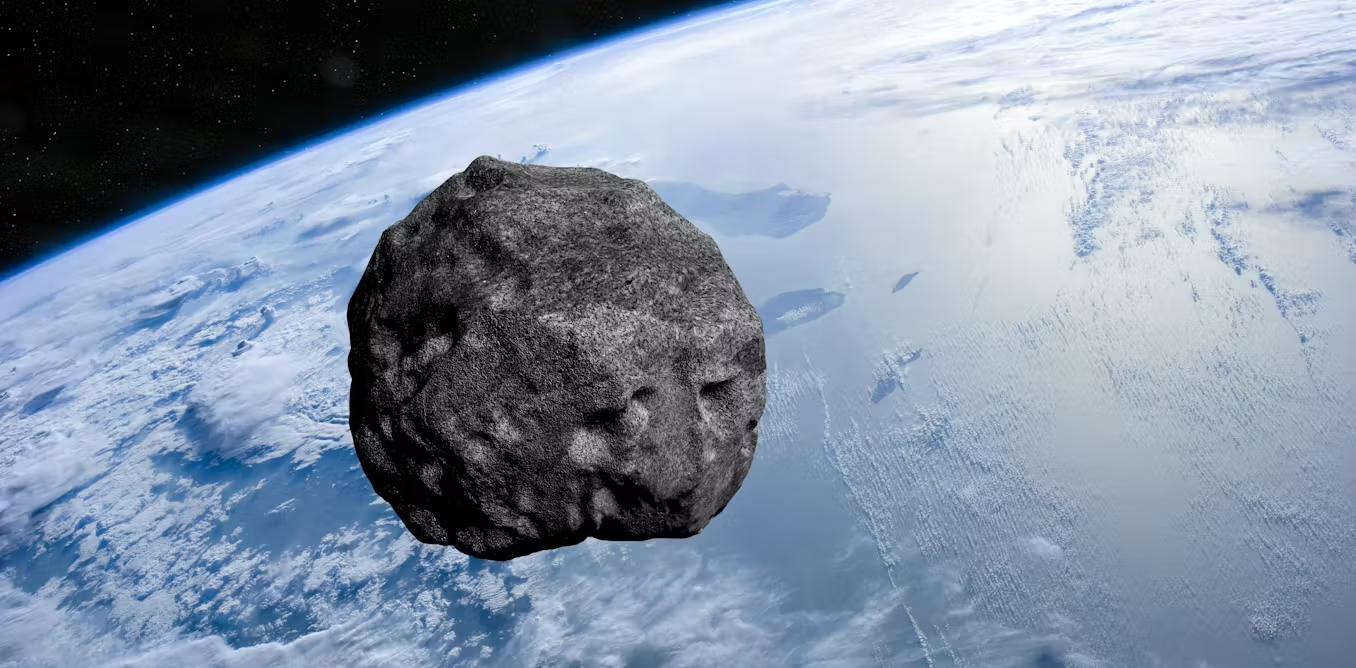
In the vast expanse of our cosmos, celestial objects frequently pass close to Earth. But every so often, one object stands out and captures the imagination—and concern—of scientists and the public alike. Asteroid 2024 YR4 is one such object. Initially feared as a potential threat to Earth, its story has evolved into one of intrigue, opportunity, and an exciting scientific possibility: a potential collision with the Moon.
Initial Alarm: A Record-Setting Risk to Earth
Asteroid 2024 YR4 burst into scientific conversations in late December 2024 when astronomers first identified it. What made this asteroid immediately noteworthy was the sheer size of the initial impact probability. According to early calculations, it had a 3.1% chance of striking Earth on December 22, 2032. While that may sound low, it’s actually the highest impact risk ever recorded for any near-Earth object (NEO) in modern observation history.
This probability was concerning because 2024 YR4 isn’t a tiny rock. Initial size estimates suggested it measured between 40 to 90 meters in diameter. Even on the smaller end of that scale, it could cause devastation if it were to strike a populated region—comparable to the 2013 Chelyabinsk meteor, which injured over 1,500 people.
Planetary defense teams worldwide, including NASA and the European Space Agency (ESA), immediately flagged the asteroid for priority observation. Telescopes across the globe pivoted to track it, and data poured in rapidly.
Recalculations Reveal Earth is Safe
With each new observation, the picture became clearer. The real breakthrough came when the James Webb Space Telescope (JWST)—more known for peering into the early universe—was pointed at the asteroid. Webb provided high-precision thermal data, which helped refine models of the asteroid’s path.
These updated calculations revealed that 2024 YR4 poses no real threat to Earth. The updated probability of impact is now just 0.001%, which effectively rules out the chance of a collision. In short, Earth is safe.
But as one risk faded, a new possibility emerged.
A New Possibility: Impacting the Moon
Once Earth was no longer the target, scientists turned their attention to other celestial bodies in 2024 YR4’s potential path—and the Moon came into focus. Based on the same set of observations, a new estimate emerged: there is a 3.8% chance that the asteroid could strike the Moon on December 22, 2032.
While this probability is still relatively low, it has excited scientists rather than alarmed them. Unlike Earth, the Moon is uninhabited and lacks an atmosphere, making it an ideal testbed for studying asteroid impacts. According to ESA’s head of planetary defense, Richard Moissl, a Moon impact would be a “perfect opportunity” to observe and study such a collision in real time.
Size Matters: A Building-Sized Intruder
With refined data from Webb, scientists now estimate that asteroid 2024 YR4 is between 53 to 67 meters in diameter. For context, that’s roughly the height of a 15-story building. This size crosses the 50-meter threshold that typically triggers planetary defense response plans. If it had still posed a risk to Earth, we would likely already be planning deflection missions.
Its size also means that if it does hit the Moon, it would create a substantial crater and eject a significant amount of lunar material. This kind of event is not only visually spectacular but also extremely informative.
What a Lunar Impact Could Teach Us
A Moon strike could provide an incredible scientific opportunity. Unlike Earth, which has an atmosphere that burns up smaller incoming objects and erosion that wears down impact sites, the Moon preserves impact craters for billions of years. Observing the creation of a new one in real time would be unprecedented.
This event would allow scientists to:
- Study crater formation and impact dynamics in a controlled environment
- Analyze the ejected lunar material to learn more about the Moon’s geology
- Gather valuable data for improving planetary defense simulations and future deflection strategies
As Mark Burchell, a space scientist at the University of Kent, pointed out, a Moon hit would be a “great experiment” and a rare chance to watch such a phenomenon unfold from Earth—possibly even with binoculars.
James Webb’s Role in Asteroid Detection
What makes this event even more special is the role played by the James Webb Space Telescope. Originally designed to look deep into space and study the early universe, Webb has proven to be an invaluable tool for solar system science as well.
Its infrared instruments allowed scientists to gather thermal data on 2024 YR4. These observations revealed that the asteroid spins very fast and likely lacks fine-grained regolith (dust and sand) on its surface—features more common in small, fist-sized asteroids than in city-killer ones.
This unusual surface composition might affect how the asteroid behaves if it collides with the Moon. These insights are not just academic—they inform how we model asteroid impacts, which in turn influences planetary defense planning.
Planetary Defense: Lessons Learned
2024 YR4 is now seen as a case study in how quickly an asteroid threat can evolve—and how prepared we need to be. If the asteroid’s path had held its original course, we might already be planning a deflection mission, much like NASA’s DART mission in 2022.
The DART mission proved that humanity could, in fact, alter an asteroid’s course by crashing a spacecraft into it. That was on a small, non-threatening asteroid. But YR4 represents a larger, more complex challenge. Monitoring it so closely and adapting our understanding of its trajectory is exactly the kind of real-world test our planetary defense systems need.
An Eye on the Future: More Observations Coming
NASA and ESA have confirmed that 2024 YR4 will be observed again next month, with both space- and ground-based telescopes contributing to a clearer picture. These follow-up observations will further narrow down the trajectory and help confirm (or disprove) the Moon impact possibility.
If it turns out that the asteroid will indeed strike the Moon, agencies could begin preparing observation campaigns using satellites, lunar orbiters, and Earth-based telescopes. Such a campaign would be historic—not only for the data it would yield but for the public spectacle it could create.
Imagine looking up at the Moon in late 2032 and seeing a visible impact flash. It’s the kind of real-world cosmic event that could inspire a new generation of scientists, engineers, and explorers.
Conclusion: A Threat Turned Opportunity
Asteroid 2024 YR4 is no longer a danger to Earth, but it has become something perhaps even more valuable: a cosmic experiment in the making. What began as a potential city-killer now offers a rare chance for discovery, learning, and awe. It is a shining example of why space observation, investment in telescopes like Webb, and international collaboration in planetary defense are all so critical.
So while we may not need to worry about an asteroid wiping out a city in 2032, we might be lucky enough to witness a new lunar crater forming before our eyes—and that’s a celestial show worth watching.


